Ghost of a girl
Posted in: Architectural Gems Castles & Palaces Curiosities Emilia-Romagna Legends Must See Attractions Northeast Italy Tourist Attractions
This week, in preparation for the spooky season that is swiftly descending upon us, and as people consider planning last-minute mid-term break, half-term, or Hallowe’en getaways, we have been looking at some of the spookiest places, attractions, and destinations in Italy. If you wanted to pay a visit to Bologna, after you have found a vacation rental in Emilia Romagna, then you’re in luck as it is home to the Villa Malvasia, often known as the Villa Clara, which is said to be one of the most haunted places in Italy. Come take in the history, culture, and heritage of Bologna, and her creepier aspects on a once-in-a-lifetime spooky and seasonal trip to Italy!

Located on via Zanardi 449 the Villa Malvasia immediately stands out as a creepy and dilapidated shell of an abandoned and formerly beautiful mansion. Like a lot of castles and old mansions in Italy, it is steeped in local legends and, in this case, a rather disturbing one.

The villa is also known as Villa Clara due to one of the supposed former residents of the building, who is said to stay on as a ghost. Clara was said to have been the daughter or stepdaughter of an owner of the villa who was born with an especially strong gift of clairvoyance. Any dream or vision she had was more than sure to come true. Her father feared her gift and is said, in local mythology, to have locked her away and allowed her to die.

Rocca Sinibalda
Posted in: Architectural Gems Castles & Palaces Central Italy Curiosities Latium Museums & Galleries Must See Attractions Tourist Attractions
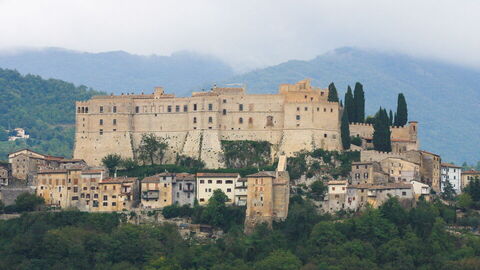
In the last few years, an incredibly interesting castle reopened to the public after being abandoned for half a century, close to a decade of restoration, and millions of euros were poured into the project. With almost a thousand years of history, the Rocca Sinibalda is an astounding fortress located in Latium, 50 miles north of Rome. Positioned majestically on a rocky outcrop that overlooks the Turano Valley, the castle-fortress is first noted in records with the building of a classic Norman stronghold by Count Sinibaldo, the governor of the Sabina area, in the 11th century. It is an extraordinary place, steeped in history and culture, stuffed with artistic gems, with a unique architectural character, and countless stories of scandal and mischief held within its walls. So, if you’re interested in art, architecture, pretty castles, or a little bit of historic gossip, then this fascinating place is a must see for those who have found a holiday rental in Rome or a vacation rental in Latium and are planning on exploring the wider region.

While the Rocca Sinibalda looks like a typical and romantic medieval fortress from a distance it is, in fact, far more interesting and complex than that. It has several names, for one thing. One of its names, the “Castle of the Eagle”, refers to the unusual shape of the building: in addition to the expected bastion walls, battlements, and lookout turrets, there are also sixteenth century additions that make the whole thing vaguely “eagle-shaped”, including the two wing-like bastions jutting out at the rear and the pointed “beak” at the front of the building, which overlooks the town below. Another named attributed to the castle is the “Castle of Metamorphoses” and the plaque by the main entrance declares it to be the “Castle of Invented Destinies.” Each of these names refers to different periods and incidents from the history of the building, with the Metamorphoses coming from a series of 16th century wall paintings and grotesques inspired by Ovid’s myths of transformation that is located in the reception rooms of the piano nobile.
Posted in: Architectural Gems Main Islands Must See Attractions Sicily and Sardinia Tourist Attractions
We have previously noted the influence that the Normans and Arab rulers had on Sicily during periods of rule in the Middle Ages, with the Islamic Conquest of 827-1091AD and the Norman era of 1071-1194AD, and how the two cultures remain visible in many places throughout the island. This leftover of the Middle Ages is particularly evident in the city of Palermo, which is a melting pot of Italian, Norman and Middle Eastern cultures and influences, and especially in her architecture. Norman buildings are dotted throughout the island of Sicily – Castelvetrano’s 12 century church of SS. Trinità di Delia, Cefalù’s Cathedral, Monreale’s Cathedral and cloister, and the church of SS. Pietro e Paolo a few kilometres outside of Forza d'Agrò, to name a few – but there are multiple buildings Arab-Norman buildings in Palermo including the Sala di Ruggero in the Royal Palace and the churches of Santo Spirito and San Giovanni degli Eremiti. One of the places and buildings that is most famous, beautiful, and clearly influenced by the wonderful marriage of these two cultures, however, is the stunning Cappella Palatina. The open exchange of Western and Middle Eastern cultures is at its peak here and it is a must-see if you have found a vacation rental in Palermo.

Located on the second floor of the Palazzo dei Normanni (Palace of the Normans), the Cappella Palatina is part of the architectural complex of the Norman Palace and was built as the royal chapel of the Norman kings of Sicily in 1140 for Ruggero II of Sicily. Bringing together the best artisans, materials, techniques, and motifs from all across the extended Norman world, it is an incredible jewellery box of a building. On the plan of a traditional Roman basilica, the chapel has three naves and carries a vaulted wooden roof on rows of granite columns with Cipolin Corinthian capitals bearing Islamic ogive arches. Said roof is covered in elaborate muqarnas, incredible traditional Islamic geometric designs. The walls of the church, however, are the true star of the show, covered in breath-taking Byzantine mosaics that are picked out in gold and vibrant colours.
Place Moulin Dam
Posted in: Aosta Valley Architectural Gems Northwest Italy Pretty Views Tourist Attractions
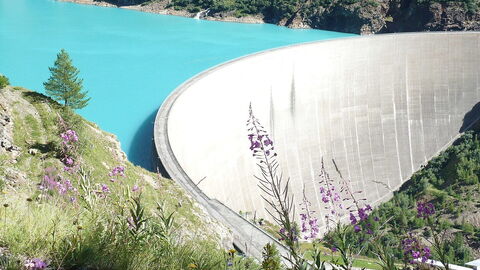
If you are interested in colours that seem too vivid to occur in the real world and picture-perfect views, there are several contenders for spots to visit that meet these requirements all around Italy. However, there is one sight in particular that makes us want to hop on the next plane and go see it with our own eyes right now: the Place Moulin Dam.

Also known as the Lago Place Moulin or the Lac de Place-Moulin, it is located in the Aosta Valley, in the very north of Italy, amongst the Italian Alps. This is an incredibly scenic and beautiful part of the world, in general, with lots to see and a landscape that rewards the more adventurous traveller. This emerald gem, nestled amongst the Italian Alps is a particularly stunning find. If you have found a vacation rental in the Aosta Valley and are exploring the area by car or bike, we recommend that you make this one of your pit stops on your road trip across one of the most scenic landscapes in the world.
Chiostro di San Francesco, Sorrento
Posted in: Architectural Gems Campania Churches & Religious Buildings Pretty Views Southern Italy Tourist Attractions
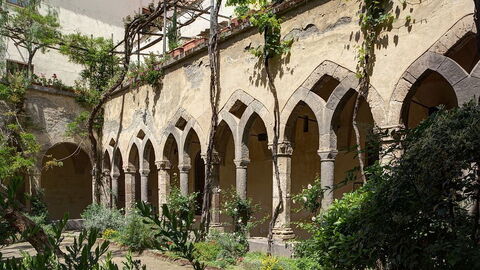
Sorrento is a beautiful gem of a town on the Amalfi Coast. Facing out onto the bay of Naples, it is perched atop a cliff, boasting sweeping views over the coast, at the base of which there is a busy marina. This stacking of the town gives it that distinct and picture-perfect look that lots of the towns in the area have: glittering water with bobbing boats topped by rows of colourful buildings. The charming old town is a warren of little streets and alleys that are lined with pretty historic buildings but amongst all of the pretty parts that make up this picturesque town, one of the most charming and unmissable sights and sites is the Chiesa di San Francesco and its lovely cloister. If you have found a vacation rental in Sorrento and you are exploring the town, be sure to duck in for a moment amidst your holiday wanderings and fun and enjoy a spot of tranquillity in the most fairytale-like of settings in Italy.

Located in the historic centre of the town, in Piazza Francesco Saverio Gargiulo, right next to the Villa Comunale Park, this 14th-century church with said iconic cloisters abutting it is famous for its Arabic portico and interlaced arches, which are interwoven with flowers, plants, and ornamental trees. The beautiful space is also often filled with birdsong, particularly in spring, as it is very popular amongst feathered locals.