Krampus
Posted in: December Events Friuli Venezia Giulia History Legends Northeast Italy Tourist Attractions
In our previous article, we discussed the legend of Krampus, the scary anti-Santa that originated in Germany and mentioned that there are festivals dedicated to him each year during the festive season all over Europe. Such celebrations take place in Austria, Germany, Hungary, Slovenia, and the Czech Republic and involve drunken men dressed as devils, who take over the streets for a Krampuslauf, chasing people around. However, there are also many in Italy specifically.

Krampus's frightening presence was suppressed for many years as the Catholic Church forbade the raucous celebrations and fascists in World War II Europe found Krampus thought him a deplorable creation of the Social Democrats. Nowadays, however, he is appearing in popular culture more and more often – there was even a feature-length movie about the legend released in theatres in 2015 – and Krampus festivals are also increasingly popular. In fact, it has come to the stage where these events are even being labelled as commercialised and selling out!

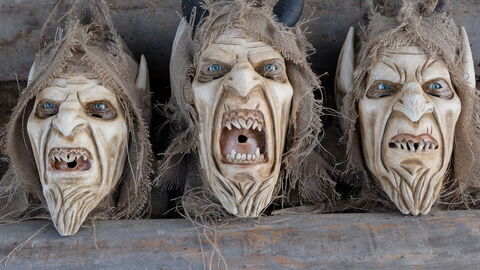
Around December 5th, several municipalities and towns in the Tarvisio area, namely such as Tarvisio, Fusine, Coccau, Malborghetto, Camporosso, Rutte, Cave del Predil and Pontebba all have Krampus celebrations. At dusk, a rite takes place that is an allegory of the eternal fight between good and evil. The Krampus figures wear monstrous masks with big red, white or naturally coloured horns, long red tongues and fangs and holding their walking stick and bundles of sticks and wearing big bells and chains to announce their arrival. They appear on the streets, accompanying St. Nicholas, passing through the main road of the town carrying torches and bundles of canes, and dragging a cart housing the Saint.

The figures make guttural sounds and move with aggressive attitudes and chase children, and sometimes the adults, to whip them, make them kneel down and recite prayers. In Pontebba, the Krampus are called Spitz Parkli but the rite is essentially the same as in other towns. In some towns, at the end, a bonfire is lit and the Krampus dance around it. Back in ancient times, the pagan festival did not have the figure of St. Nicholas. It was not until medieval times that he was introduced as a positive moderator.

Silly, raucous and vibrant, the festival is a fun event that takes place in the run up to Christmas. If you are curious about Krampus, just find a vacation rental in Friuli Venezia Giulia and indulge a creepier festive tradition this or next Christmas.
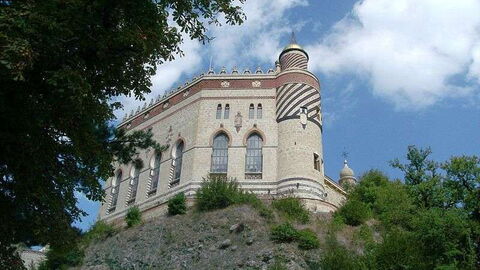
Rochetta Mattei, exterior
Posted in: Architectural Gems Castles & Palaces Emilia-Romagna Northeast Italy Northwest Italy Piedmont Tourist Attractions Water & Amusement Parks
Italy is known as a world-class leader in art and design. Many movements and styles were born or mastered in Italy over the century. The Renaissance, in particular, forever changed art and architecture in the western world. However, for all of the architectural gems that exist in Italy, there are also some rather bizarre buildings. These might, equally, be beautiful but are definitely odd.

One of the strangest architectural ventures in Italy is the Rocchetta Mattei, a magnificent castle located in the northern part of the Tosco-Emiliano Apennines, in the province of Bologna. It is an exceptionally eccentric building that speaks to its former owner, a similarly strange character. The earl Cesare Mattei, who had the castle built in the 19th century, was the inventor of "electrohomeopathy," a medical practice said to cure cancer. His methods have been largely debunked but he showed his eccentricity in his personal life and tastes as well, as can be seen throughout the castle.
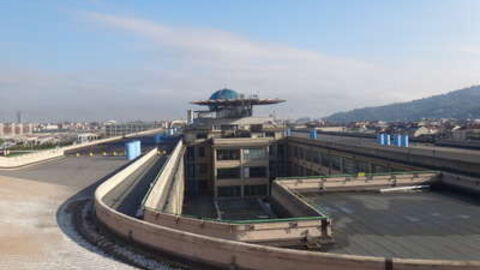
Rooftop test track, Fiat Lingotto
Posted in: Architectural Gems Campania Curiosities Must See Attractions Northwest Italy Piedmont Southern Italy Tourist Attractions
There is lots to see and do in Italy but we have rounded up a list of some particularly intriguing attractions and sights that we have dubbed the Seven Wonders of Italy and, continuing from the last article, here are some more of said wonders.

The Fiat Lingotto Factory in Turin was built in the 1920s and was the largest and most modern car manufacturing plant in Europe and second in the world at the time. It is five storeys high with a test track atop the roof and cars were moved upwards from floor to floor to be tested on the track when completed. The factory was eventually closed in 1982 but, in 1985, it was converted and made into a multi-purpose centre and is now used commercially by various companies. The exterior is largely unchanged but the interior has been drastically redesigned in order to house an exhibition centre, a conference centre and auditorium, two hotels, offices and retail space.
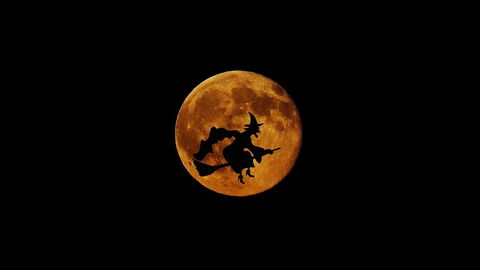
Witch
Posted in: Curiosities Legends Liguria Localities Must See Attractions Northwest Italy Small Towns Tourist Attractions
America has Salem and Italy has Triora in Liguria.

This charming town's appearance does not belie its troubled and bloody past and will forever be interconnected with witches and witchcraft.

It all goes back to 1587, when bad weather and a bad harvest lead locals from the town to speculate as to what was causing all of their misfortune. They came to the logical conclusion: it had to be the fault of witches. The rest, as they say, is history.

Find a holiday rental in Liguria and you can uncover this disturbing and fascinating history for yourself, all while enjoying the delightful town that Triora is today.
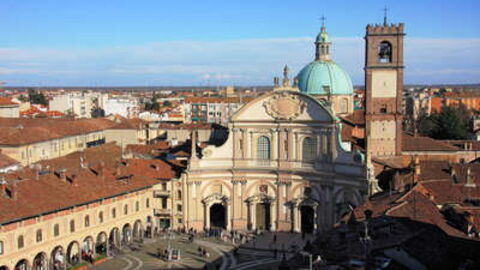
Cathedral of St Ambrose, Vigevano
Posted in: Architectural Gems Churches & Religious Buildings Liguria Lombardy Must See Attractions Northwest Italy Tourist Attractions
Continuing on from our last article, this piece will discuss some more of our picks for the Seven Wonders of Italy.

The Cathedral of St. Ambrose is a building in Lombardy with roots going as far back as the tenth century, though the present structure dates to the sixteenth. It is the seat of the Bishop of Vigevano and the current building was commissioned by Duke Francesco II Sforza in 1530.

Dedicated to St. Ambrose, it was designed by Antonio da Lonate and thought it was begun shortly afterwards, work was not completed until 1612.

With beautiful painted interiors, a newer Baroque façade and a famous treasury and museum inside, it is a typical Italian cathedral in many ways.