Italy is home to plenty of castles that have existed for hundreds of years and, as is often the case with things and places that have existed for hundreds of years and with castles, in particular, this means that there are also plenty of haunted castles throughout the country. Among them, one of the most famous is the castle of Montebello, which is located a hamlet of Borgo Montebello, in the municipality of Poggio Torriana, Rimini. The Castello di Montebello is famous for the tale of Azzurrina, a noble girl who lived there in the 14th century, and the legend and stories of hauntings that surround both her and the castle. Open to the public as a museum, the castle is one of the easiest haunted places to visit in Italy and is a must-see for anyone who has found a vacation rental in Rimini or a holiday rental in Emilia Romagna and is planning a trip over mid-term break or around Hallowe’en. Come have a spooky experience in this fascinating gem!
The story goes that Guendalina Malatesta was born around 1370 to Ugolinuccio, or Uguccione, the feudal lord of Montebello. Unfortunately, when she was born, the family was filled with dread instead of joy as she was an albino. In the Middle Ages albinism was a symbol of great misfortune and connected to events of a diabolical nature, according to popular superstitions, and albinos were often accused of being witches and burned at the stake. Fearing for their child and her future, the lord and lady came up with a plan to dye her hair. However the dye didn’t take in her incredibly pale hair and went blue instead of black, leaving the girl with striking blue eyes and hair, lending the nickname, “Azzurrina” (little blue one). This failed experiment meant that the poor child still stuck out like a sore thumb and it was decided to assign two guards to the child at almost all times and prevent her from leaving the castle.

14
Oct
2019
2019
The Lagoon of Venice is made up of a whopping 166 little islets, all of which are home to special gems and surprises that are just waiting to be discovered. Of course, in a city so diverse and unusual and ancient, there is a great wealth of history and nestled amongst the defining events and larger moments, there are tales of ghosts, ghouls, goblins, and more. There are ghost tours of the city that can be done, famously haunted buildings, and much more besides but there is also an entire islet in the lagoon that is a spooky destination considered to be one of the most haunted places in all of Italy. If you’re looking for a spot for a creepy and spooky mid-term break or October getaway, then look no further than Venice! Just browse our vacation rentals in Venice and get planning your trip today.
Said haunted islet is Poveglia Island, located between Venice and the Lido in the Venetian Lagoon. First mentioned in writing in the early 5th century as a safe haven from invasions by Alaric the Goth and Attila the Hun during the decline of the Roman Empire, though it is though to have been inhabited since as early as 2,000 BC, it has gone on to be used for various purposes throughout the centuries. In the 14th century, residents were removed and it was made into a military outpost to secure the lagoon and during the Bubonic Plague (in the 16th and 17th centuries), it was a mass burial ground for the contagious dead and a place where the ill were quarantined. Anyone who showed signs of the illness was whipped away from their families and sent to the island. If they were better after 40 days of quarantine, they could return home but few ever did. Thousands of bodies were incinerated on the island.
Said haunted islet is Poveglia Island, located between Venice and the Lido in the Venetian Lagoon. First mentioned in writing in the early 5th century as a safe haven from invasions by Alaric the Goth and Attila the Hun during the decline of the Roman Empire, though it is though to have been inhabited since as early as 2,000 BC, it has gone on to be used for various purposes throughout the centuries. In the 14th century, residents were removed and it was made into a military outpost to secure the lagoon and during the Bubonic Plague (in the 16th and 17th centuries), it was a mass burial ground for the contagious dead and a place where the ill were quarantined. Anyone who showed signs of the illness was whipped away from their families and sent to the island. If they were better after 40 days of quarantine, they could return home but few ever did. Thousands of bodies were incinerated on the island.
Posted in: Books and Movies
Curiosities
Food and Wine
Main Islands
Must See Attractions
Restaurants & Cafés
Sicily and Sardinia
One of the most enduringly famous portrayals of Sicily that has ever graced the silver screen has to be Francis Ford Coppola’s 1972 masterpiece, “The Godfather”, starring Marlon Brando and Al Pacino. This iconic movie is set in 1940s and 1950s Sicily and New York and tells the story of the Corleone family, characters from Mario Puzo’s novel, “The Godfather.” Many tourists have gone in search of filming locations from the movie throughout the years since its release. Many head to Corleone, the town that shares its name with Don Vito Corleone, but it was not actually where the film was shot as when they began making the movie in the 1970s, it had changed drastically in the time since Puzo wrote his novel. Modernised and greatly expanded, it no longer resembled the rural place from the books. However, never fear, if you have found a vacation rental in Sicily and are a fan of the movie, there are plenty of filming sites to visit as the villages of Motta Camastra, Forza d’Agro, and Savoca were all featured in, “The Godfather”.
Posted in: Curiosities
Liguria
Must See Attractions
Northwest Italy
Parks & Gardens
Tourist Attractions
Some travellers are not content with doing what everyone else does on holidays. They don’t want the standard photos or to line up for hours for famous attractions or to mill in crowds of people. Instead, they want to explore, get off the beaten tourist path, and see beyond the brochures and Instagram to find the hidden gems that a destination has to offer. If you have found a vacation rental in Liguria and are exploring this beautiful coastal region of Italy, then we recommend heading to one beach, in particular, and not because it is a popular tourism spot but, rather, because of something that lies beneath the waves…
Noli, a pretty seaside town around 50km from Genoa, in Liguria, is home to a rather fascinating garden. This may seem like a bold claim in a country like Italy where there are endless beautiful gardens belonging to ancient estates, hidden amongst winding streets in city centres, housing incredible works of art and rare blooms, and much more besides but this garden is truly worth being set aside as something extra special. Why, you may ask? Well, for one thing, it’s an underwater farm. That’s something you don’t see every day, that’s for sure!
Noli, a pretty seaside town around 50km from Genoa, in Liguria, is home to a rather fascinating garden. This may seem like a bold claim in a country like Italy where there are endless beautiful gardens belonging to ancient estates, hidden amongst winding streets in city centres, housing incredible works of art and rare blooms, and much more besides but this garden is truly worth being set aside as something extra special. Why, you may ask? Well, for one thing, it’s an underwater farm. That’s something you don’t see every day, that’s for sure!
23
Sep
2019
2019
Posted in: Architectural Gems
Castles & Palaces
Central Italy
Curiosities
Latium
Museums & Galleries
Must See Attractions
Tourist Attractions
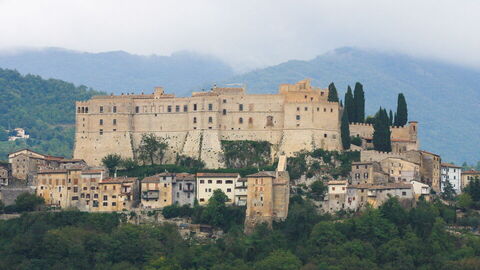
In the last few years, an incredibly interesting castle reopened to the public after being abandoned for half a century, close to a decade of restoration, and millions of euros were poured into the project. With almost a thousand years of history, the Rocca Sinibalda is an astounding fortress located in Latium, 50 miles north of Rome. Positioned majestically on a rocky outcrop that overlooks the Turano Valley, the castle-fortress is first noted in records with the building of a classic Norman stronghold by Count Sinibaldo, the governor of the Sabina area, in the 11th century. It is an extraordinary place, steeped in history and culture, stuffed with artistic gems, with a unique architectural character, and countless stories of scandal and mischief held within its walls. So, if you’re interested in art, architecture, pretty castles, or a little bit of historic gossip, then this fascinating place is a must see for those who have found a holiday rental in Rome or a vacation rental in Latium and are planning on exploring the wider region.
While the Rocca Sinibalda looks like a typical and romantic medieval fortress from a distance it is, in fact, far more interesting and complex than that. It has several names, for one thing. One of its names, the “Castle of the Eagle”, refers to the unusual shape of the building: in addition to the expected bastion walls, battlements, and lookout turrets, there are also sixteenth century additions that make the whole thing vaguely “eagle-shaped”, including the two wing-like bastions jutting out at the rear and the pointed “beak” at the front of the building, which overlooks the town below. Another named attributed to the castle is the “Castle of Metamorphoses” and the plaque by the main entrance declares it to be the “Castle of Invented Destinies.” Each of these names refers to different periods and incidents from the history of the building, with the Metamorphoses coming from a series of 16th century wall paintings and grotesques inspired by Ovid’s myths of transformation that is located in the reception rooms of the piano nobile.
While the Rocca Sinibalda looks like a typical and romantic medieval fortress from a distance it is, in fact, far more interesting and complex than that. It has several names, for one thing. One of its names, the “Castle of the Eagle”, refers to the unusual shape of the building: in addition to the expected bastion walls, battlements, and lookout turrets, there are also sixteenth century additions that make the whole thing vaguely “eagle-shaped”, including the two wing-like bastions jutting out at the rear and the pointed “beak” at the front of the building, which overlooks the town below. Another named attributed to the castle is the “Castle of Metamorphoses” and the plaque by the main entrance declares it to be the “Castle of Invented Destinies.” Each of these names refers to different periods and incidents from the history of the building, with the Metamorphoses coming from a series of 16th century wall paintings and grotesques inspired by Ovid’s myths of transformation that is located in the reception rooms of the piano nobile.