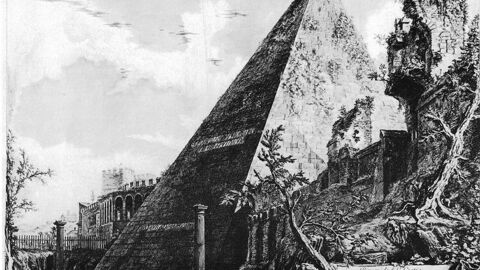
Piranesi, Pyramid of Cestius
Posted in: Architectural Gems Central Italy Curiosities Latium Tourist Attractions
When you think of pyramids, you're likely to imagine a sandy desert in Egypt. You're less like to think of the heart of the city of Rome and, yet, that's exactly where a pyramid which dates back to between 18 and 12 BC is located. Although the pyramid itself is not Egyptian, it serves as a reminder of the conquest of Egypt in 30 BC and the subsequent Egyptomania that overcame Rome's citizens in its wake. All kinds of artefacts inspired by Egyptian art and culture and copies of Egyptian examples popped up all over the city.

There were, however, only two pyramids erected on Italian soil, only one of which still exists, the Pyramid of Cestius.
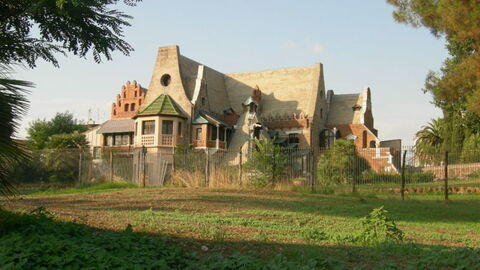
Casina delle Civette
Posted in: Architectural Gems Central Italy Latium Museums & Galleries Tourist Attractions
The Casina delle Civette, or House of the Owls, was the home of Prince Giovanni Torlonia until his death in 1938. The building was originally constructed in the nineteenth century as a “Swiss Cabin” pleasure building on the edge of the grounds of the ancestral home of Villa Torlonia. These types of buildings were used by the aristocracy across Europe to retreat from formal court life in their homes and play at simplicity. The building was designed by Giuseppe Jappelli in 1840 for Prince Alessandro Torlonia to look like a rustic dwelling. However, in the twentieth century, when his nephew, Giovanni, got his hands on the structure it became increasingly elaborate. It was transformed from a cottage into a medieval hamlet.
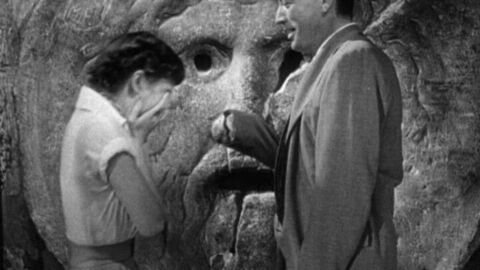
Audrey Hepburn and Gregory Peck at the Mouth of Truth in Roman Holiday
Posted in: Central Italy Latium Legends Tourist Attractions
Though you'll never be stuck for something to see or do in Rome, sometimes one becomes tired of museums and churches but if you're visiting the church of Santa Maria in Cosmedin, an oddity outside the doors will provide a little bit of fun and light relief. Dating to around the 1st century AD, the Bocca della Verità, or Mouth of Truth, is a tall stone disc with a humanoid face carved into its surface. With hollow holes for eyes and a gaping mouth, it is a somewhat alarming looking object. The original purpose is of the large medallion is uncertain but theories of all sorts of uses have flown around for centuries: everything from a ceremonial well cover, to a piece of fountain decoration, to a manhole cover.
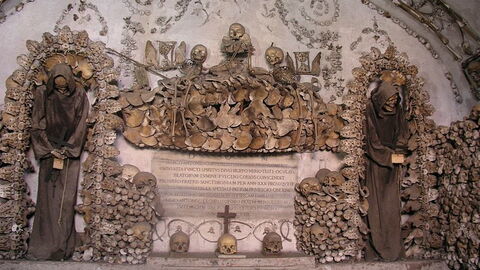
Altar in the Crypt of Santa Maria della Concezione
Posted in: Central Italy Churches & Religious Buildings Curiosities Latium Tourist Attractions
Located on the upscale Via Veneto in Rome, Santa Maria della Concezione is dedicated to Our Lady of the Immaculate Conception. It was built in 1626 by Cardinal Antonio Barberini, the younger brother of Pope Urban VIII, who was a Capuchin friar. Antonio Casoni and another Capuchin Friar, Michele da Bergamo, were the architects and they built a beautiful but simple church. The real interest in this site, however, is what lies below. When the Capuchins moved from their location at the Quirinal to the Via Veneto site, they brought the bones of around 4000 friars and placed them in a cemetery under the church, arranged in patterns on the walls and ceilings. The result is eerie and very unusual. Find a holiday rental in Rome and see it yourself.
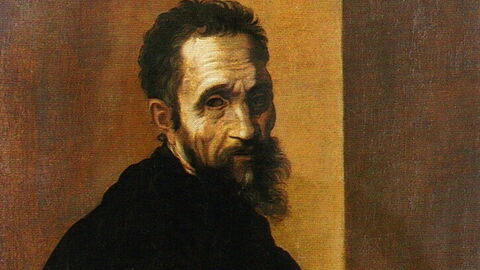
Michelangelo
Posted in: Central Italy Latium Must See Attractions Top 10 Lists
Michelangelo is one of the most famous artists in the western world, as has been the case since early on his career and will probably always be true. Born in the fifteenth century, he was a Florentine sculptor, painter, poet, architect and engineer who was prodigiously talented, an incredibly hard worker, devoted to his art to a fault and the true definition of a Renaissance man. His work is now scattered across the globe but Florence and Rome remain the best places to see his work – Rome nudging just ahead.