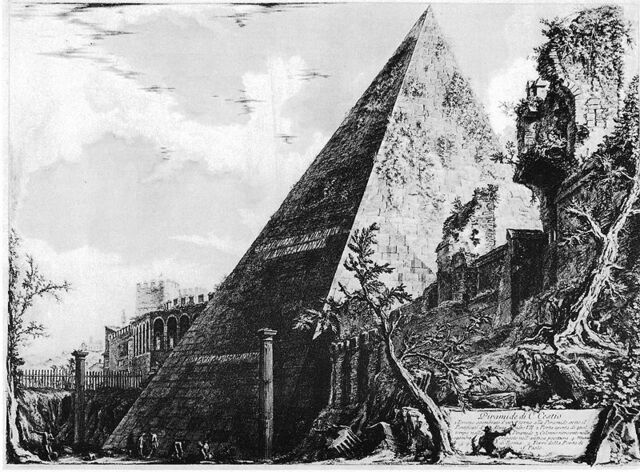
When you think of pyramids, you're likely to imagine a sandy desert in Egypt. You're less like to think of the heart of the city of Rome and, yet, that's exactly where a pyramid which dates back to between 18 and 12 BC is located. Although the pyramid itself is not Egyptian, it serves as a reminder of the conquest of Egypt in 30 BC and the subsequent Egyptomania that overcame Rome's citizens in its wake. All kinds of artefacts inspired by Egyptian art and culture and copies of Egyptian examples popped up all over the city.
There were, however, only two pyramids erected on Italian soil, only one of which still exists, the Pyramid of Cestius.
There were, however, only two pyramids erected on Italian soil, only one of which still exists, the Pyramid of Cestius.
If you're intrigued by Egypt but looking to holiday in Italy, find a holiday rental in Rome and visit this strange sight for yourself.
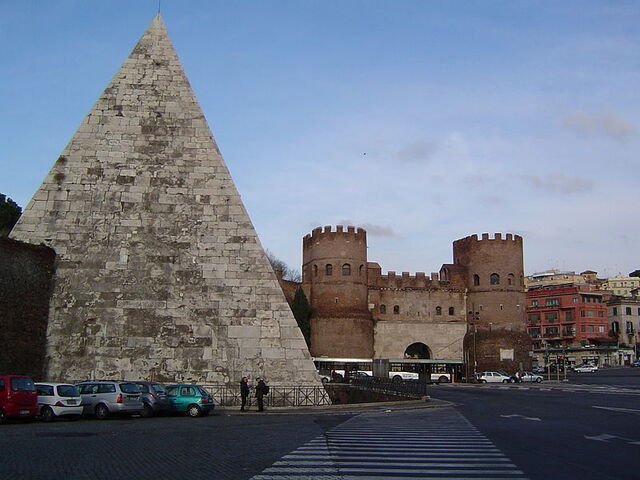
The pyramid was built as a tomb for a wealthy Roman with the money to entertain extravagant dedication to current trends. We know very little about the man who was once buried there, as the tomb was ransacked long ago and so much has changed and been lost since it was built. Once located far outside the city centre, it is now right in the middle near a major train stop. The Pyramid of Cestius is made from brick and cement and faced in white marble.
The pyramid was built as a tomb for a wealthy Roman with the money to entertain extravagant dedication to current trends. We know very little about the man who was once buried there, as the tomb was ransacked long ago and so much has changed and been lost since it was built. Once located far outside the city centre, it is now right in the middle near a major train stop. The Pyramid of Cestius is made from brick and cement and faced in white marble.
The interior was originally decorated with lively frescoes, known to us from the accounts of early travellers, but little remains of them today.
While the pyramid shows an interest in Egypt, the much steeper angle at which it rises suggests that the understanding of things may not have been particularly deep. However, it also shows the innovation of the Roman builders who, using concrete instead of giant stone blocks, could engineer these proportions. Another possibility is that this pyramid was inspired by the steeper Nubian pyramids near Jebel Barkal, now in Sudan.
Whatever the reason for their unusual shape, it has been credited as the source of oddly proportioned pyramids in European art which became prevalent.
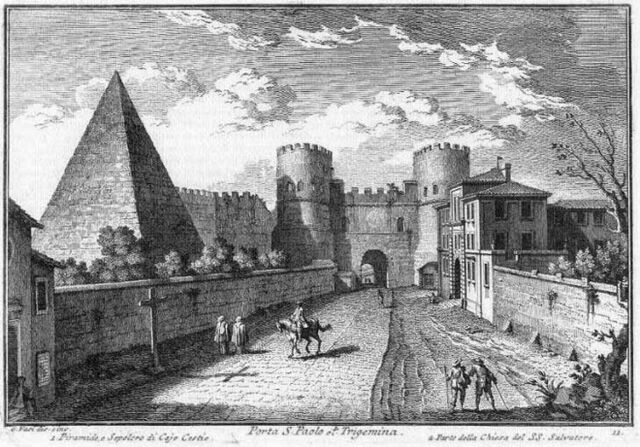
It was during this same period that the famous and iconic obelisks began to appear around the city. Two from this time remain- one in the Piazza del Popolo, and the second in the Piazza di Montecitorio. The larger pyramid which was constructed in Rome, known as the "Pyramid of Romulus" no longer exists and, in fact, its marble was used to build the stairs at St. Peter's Basilica. It is probably due to the fact that the Pyramid of Cestius was built into the fortifications of the Aurelian walls between 271 and 275 that is has managed to survive to this day.
This beautiful oddity, showing that mankind has always succumbed to the whims and fashions of their own times, is not to be missed on a visit to Rome and can be admired with ease whenever you please.
While the pyramid shows an interest in Egypt, the much steeper angle at which it rises suggests that the understanding of things may not have been particularly deep. However, it also shows the innovation of the Roman builders who, using concrete instead of giant stone blocks, could engineer these proportions. Another possibility is that this pyramid was inspired by the steeper Nubian pyramids near Jebel Barkal, now in Sudan.
Whatever the reason for their unusual shape, it has been credited as the source of oddly proportioned pyramids in European art which became prevalent.
It was during this same period that the famous and iconic obelisks began to appear around the city. Two from this time remain- one in the Piazza del Popolo, and the second in the Piazza di Montecitorio. The larger pyramid which was constructed in Rome, known as the "Pyramid of Romulus" no longer exists and, in fact, its marble was used to build the stairs at St. Peter's Basilica. It is probably due to the fact that the Pyramid of Cestius was built into the fortifications of the Aurelian walls between 271 and 275 that is has managed to survive to this day.
This beautiful oddity, showing that mankind has always succumbed to the whims and fashions of their own times, is not to be missed on a visit to Rome and can be admired with ease whenever you please.
Photo credits
picture 2: Joris van Rooden / CC BY-SA 3.0
picture 2: Joris van Rooden / CC BY-SA 3.0