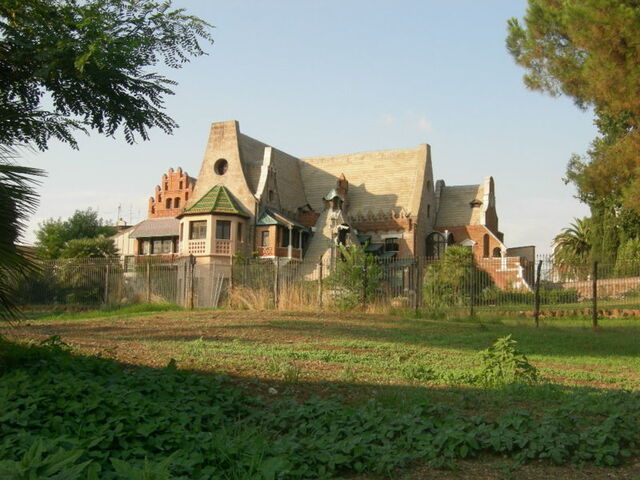
The Casina delle Civette, or House of the Owls, was the home of Prince Giovanni Torlonia until his death in 1938. The building was originally constructed in the nineteenth century as a “Swiss Cabin” pleasure building on the edge of the grounds of the ancestral home of Villa Torlonia. These types of buildings were used by the aristocracy across Europe to retreat from formal court life in their homes and play at simplicity. The building was designed by Giuseppe Jappelli in 1840 for Prince Alessandro Torlonia to look like a rustic dwelling. However, in the twentieth century, when his nephew, Giovanni, got his hands on the structure it became increasingly elaborate. It was transformed from a cottage into a medieval hamlet.
If you want to see this extraordinary structure for yourself, find a holiday rental in Rome and pay it a visit!
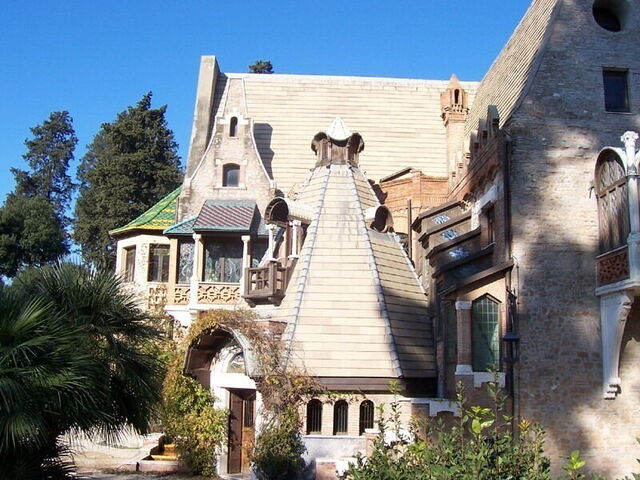
The complex now consists of two buildings, the original house plus an annex, connected by a small wooden gallery and an underground passage. These buildings stray rather far from the simple and romantic Alpine refuge planned by Jappelli, except for the deliberately rustic style and steep layered roofs. The transformation began in 1908 and was overseen by the architect Enrico Gennari, becoming an elaborate residence with huge windows, loggias, porticos and turrets, decorated with majolica and stained glass.
The complex now consists of two buildings, the original house plus an annex, connected by a small wooden gallery and an underground passage. These buildings stray rather far from the simple and romantic Alpine refuge planned by Jappelli, except for the deliberately rustic style and steep layered roofs. The transformation began in 1908 and was overseen by the architect Enrico Gennari, becoming an elaborate residence with huge windows, loggias, porticos and turrets, decorated with majolica and stained glass.
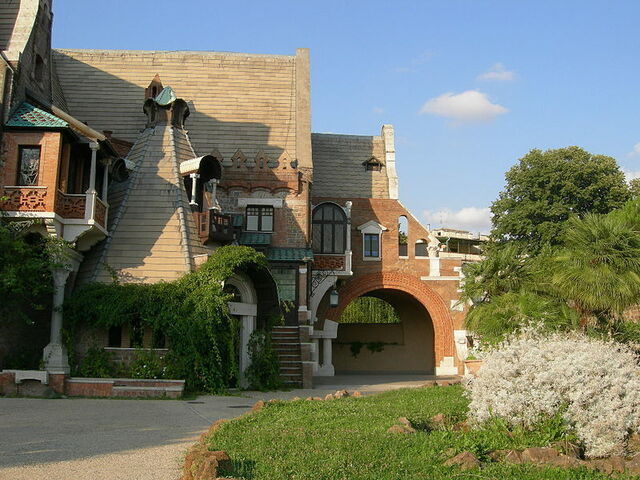
The building began to be known as the “House of the Owls”, from 1916, perhaps because of the stained glass depicting two stylised owls among ivy shoots by Duilio Cambellotti or because the motif of the owl is used almost obsessively in the decorations and furnishings of the House.
It is uncertain how exactly this name came about but it is surely connected to the eccentric whims of Giovanni.
A southern façade was added in 1917 by Vincenzo Fasolo and a decorative scheme in the Liberty style was employed. The stained glass is a distinctive feature of the house.
Installed between 1908 and 1930, it was produced in the workshops of Cesare Picchiarini to the designs of Duilio Cambellotti, Umberto Bottazzi, Vittorio Grassi and Paolo Paschetto. Occupation by Anglo-American troops in WWII led to the deterioration of the site so that when the park was purchased by the Municipality of Rome in 1978, it was in poor condition. Fires, theft and vandalism did not help matters so restoration was undertaken between 1992 and 1997.
That year, it was opened to the public as a museum of Liberty stained-glass as it is an exceptionally rich example of the early 20th century passion for the style. The twenty rooms of the museum, are decorated by painted walls, stucco work, mosaics, carved wooden panels, and 54 pieces of stained glass put back in their original settings alongside others in special display cases and preparatory sketches.
If you want to step into a fairytale hamlet filled with glittering glass, this is a romantic and fascinating spot not to be missed in Rome!
It is uncertain how exactly this name came about but it is surely connected to the eccentric whims of Giovanni.
A southern façade was added in 1917 by Vincenzo Fasolo and a decorative scheme in the Liberty style was employed. The stained glass is a distinctive feature of the house.
Installed between 1908 and 1930, it was produced in the workshops of Cesare Picchiarini to the designs of Duilio Cambellotti, Umberto Bottazzi, Vittorio Grassi and Paolo Paschetto. Occupation by Anglo-American troops in WWII led to the deterioration of the site so that when the park was purchased by the Municipality of Rome in 1978, it was in poor condition. Fires, theft and vandalism did not help matters so restoration was undertaken between 1992 and 1997.
That year, it was opened to the public as a museum of Liberty stained-glass as it is an exceptionally rich example of the early 20th century passion for the style. The twenty rooms of the museum, are decorated by painted walls, stucco work, mosaics, carved wooden panels, and 54 pieces of stained glass put back in their original settings alongside others in special display cases and preparatory sketches.
If you want to step into a fairytale hamlet filled with glittering glass, this is a romantic and fascinating spot not to be missed in Rome!
Photo credits
picture 1: Sergio de Ferra / CC BY-SA 3.0;
picture 2: MarkusMark / CC BY-SA 3.0;
picture 3: Sergio de Ferra / CC BY-SA 3.0
picture 1: Sergio de Ferra / CC BY-SA 3.0;
picture 2: MarkusMark / CC BY-SA 3.0;
picture 3: Sergio de Ferra / CC BY-SA 3.0