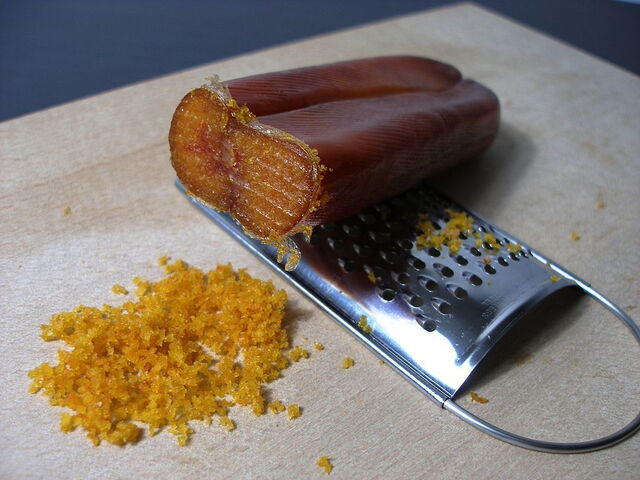
Italy is home to lots of unique culinary delicacies and specialities. Many are familiar to most people around the world and are readily available abroad but there are some that are somewhat lesser-known gems yet to be discovered by a wider international audience. One such item is bottarga, known as “Mediterranean caviar,” or as the “truffle of the sea”, which is made of salted, cured fish roe, typically of the grey mullet or the bluefin tuna. While similar products are actually made in Japan, Korea, and Egypt, the Italian iteration, with which we are concerned today comes from Sardinia but is also made in Sicily and Calabria. It is rather expensive and harder to source abroad so it is best to try as a treat during your travels if you have found a vacation rental in Sardinia, a holiday rental in Sicily, or a rental in Calabria.
The word bottarga comes from an Arabic word “battarikh” and is an ancient product that dates back to much thriftier times when fishermen were unwilling to part with any piece of the fish that they caught. This included fish eggs and, in order to preserve them, they used the common method of salting. The process has become more refined over time and, today, there are many steps involved in producing bottarga. First, the roe is carefully extracted from the belly of the fish so as not to damage the membrane containing them. Then, the sacks of fish eggs are washed in ice water (this is done multiple times if the fish in question is tuna) and massaged so as to remove any air pockets that might be trapped inside. Next, the roe is cured in sea salt for weeks. After a few weeks, they are washed again and pressed to remove the brine and any other liquids that may be still trapped inside. Now, they are ready to be aged and the slabs are brought to a wide and well-ventilated and dried ageing room in which they are hung from the ceiling or laid down on wooden shelves. They are turned periodically as they are aged in order to ensure that they dry uniformly and are left to mature for differing times based on the size of the roe but usually for several months. All of this results in dry and intensely flavoured slabs that look not unlike cured meats such as salami but are more block or pod-shaped.
Another result of this lengthy process is that bottarga is generally quite an expensive speciality product. When buying wholesale it starts at €65-70 per kilo. However, as it is often grated over dishes like parmesan or truffles or used to flavour dishes, you won’t actually need that much to appreciate its flavour. Just stock up on a little while in Italy (the best is generally from Sardinia but the Sicilian and Calabrian offerings aren’t half bad either) and have it kept aside in the kitchen to add a little extra something to your meals when you feel like treating yourself or when you are impressing guests with your culinary knowledge and prowess.
The more common variety is the bottarga made from the roe of mullet fish and it is rather sweet, with almond and musky notes, and not actually as fishy in flavour as you might expect. The tuna bottarga, meanwhile, is not as sweet, darker in colour and much fishier than the other kind. Either one, however, offers a rather unique Italian culinary experience that is a must for foodies who are exploring this part of Italy and want to try the most special and best-loved examples of local cuisine.
Another result of this lengthy process is that bottarga is generally quite an expensive speciality product. When buying wholesale it starts at €65-70 per kilo. However, as it is often grated over dishes like parmesan or truffles or used to flavour dishes, you won’t actually need that much to appreciate its flavour. Just stock up on a little while in Italy (the best is generally from Sardinia but the Sicilian and Calabrian offerings aren’t half bad either) and have it kept aside in the kitchen to add a little extra something to your meals when you feel like treating yourself or when you are impressing guests with your culinary knowledge and prowess.
The more common variety is the bottarga made from the roe of mullet fish and it is rather sweet, with almond and musky notes, and not actually as fishy in flavour as you might expect. The tuna bottarga, meanwhile, is not as sweet, darker in colour and much fishier than the other kind. Either one, however, offers a rather unique Italian culinary experience that is a must for foodies who are exploring this part of Italy and want to try the most special and best-loved examples of local cuisine.
Photo credit: Radobera / CC BY-SA 3.0