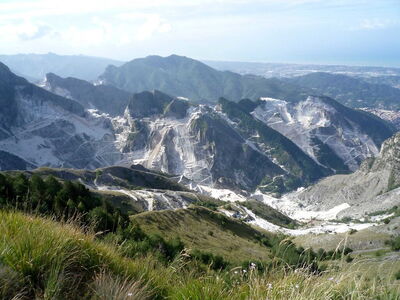
Tuscany is home to the Apuan Alps, a mountain range nestled between the valleys of the Serchio and Magra rivers, not far from the Garfagnana and Lunigiana areas. It is a beautiful part of the world that boasts even more beautiful views over the picturesque and distinctive landscape of Tuscany. Monte Sagro then, is a mountain in the Apuan Alps, overlooking the city of Carrara, that is one of nine main peaks in the range and an excellent place to go hiking if you have found a vacation rental in Carrara and want to get some fresh air and stretch your legs.
Located closest to the sea, in the northern part of the mountain range, Monte Sagro means holy or sacred mountain and there are several theories as to how this name first originated. According to one theory, the mountain is said to have been a sacred place for the ancient Liguri tribe, along with Monte Bego, which is located at the modern border between France and Italy. It is thought that these Ligurian-Apuan people, with Pliny the Elder noting this belief, believed the mountain to be home to a generous god who was prone to blessing them with rain. Other ideas about how it became a sacred mountain include its grandeur simply attracting such a name, or the idea that its particularly elegant pyramidal shape warranted the title, or because it was one of the main sanctuaries of the ancient Ligurian-Apuan people and allowed direct visual communication with Monte Penna, another important mountain for the local tribes. All of these theories come from the same period and all suggest that, though we do not know which one is exactly right (or if it might not actually be a combination or blend of these reasons), this grand and imposing mountain, usefully positioned for communication and for attracting clouds and rain, has long captured the imagination of those who saw it.
Located closest to the sea, in the northern part of the mountain range, Monte Sagro means holy or sacred mountain and there are several theories as to how this name first originated. According to one theory, the mountain is said to have been a sacred place for the ancient Liguri tribe, along with Monte Bego, which is located at the modern border between France and Italy. It is thought that these Ligurian-Apuan people, with Pliny the Elder noting this belief, believed the mountain to be home to a generous god who was prone to blessing them with rain. Other ideas about how it became a sacred mountain include its grandeur simply attracting such a name, or the idea that its particularly elegant pyramidal shape warranted the title, or because it was one of the main sanctuaries of the ancient Ligurian-Apuan people and allowed direct visual communication with Monte Penna, another important mountain for the local tribes. All of these theories come from the same period and all suggest that, though we do not know which one is exactly right (or if it might not actually be a combination or blend of these reasons), this grand and imposing mountain, usefully positioned for communication and for attracting clouds and rain, has long captured the imagination of those who saw it.
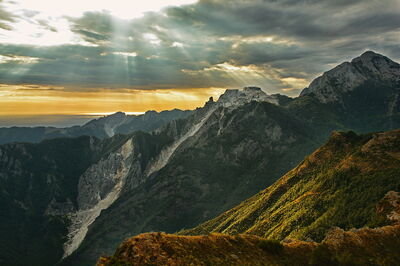
The impressive and striking Monte Sagro continues to impress and draw visitors to this day. It is also the most westerly peak in the Apuan Alps and more isolated in comparison to other mountains in the range and, therefore, it affords some of the most scenic and extraordinary views over the surrounding area. It is also one of the easier climbs in the area and is one of the most visited and climbed mountains as a result. In addition to the views from the mountain itself and the overall shapely form that so captured the imagination of ancient locals many centuries ago, the mountain is made more interesting by being part of the Carrara area where the marble in which Florence, and many more buildings around the world, are clad and is, therefore, home to several marble quarries.
These jagged cliffs and hollowed out quarries make for a rather breath-taking diversity of landscape that captures the imagination. During an outing of the Italian Alpine Club in 1876, the geographer Giovanni Marinelli best described the uniquely captivating landscape of the mountain thusly: “… an abyss of maybe 700 meters, broken, jagged with cliffs in weird shapes, carved by gorges, by gullies several meters wide, separated from each other by sharp pointed barbicans …”. Yet, in contrast to this rugged charm, the mountain actually resembles a large grassy blade from the coast and is also a colourful beauty; green in spring, yellow in summer and autumn, white in winter. And while this white is not always the thick blanket that other Italian peaks boast – depending on the year – the mountain is home to two skiable slopes.
These jagged cliffs and hollowed out quarries make for a rather breath-taking diversity of landscape that captures the imagination. During an outing of the Italian Alpine Club in 1876, the geographer Giovanni Marinelli best described the uniquely captivating landscape of the mountain thusly: “… an abyss of maybe 700 meters, broken, jagged with cliffs in weird shapes, carved by gorges, by gullies several meters wide, separated from each other by sharp pointed barbicans …”. Yet, in contrast to this rugged charm, the mountain actually resembles a large grassy blade from the coast and is also a colourful beauty; green in spring, yellow in summer and autumn, white in winter. And while this white is not always the thick blanket that other Italian peaks boast – depending on the year – the mountain is home to two skiable slopes.
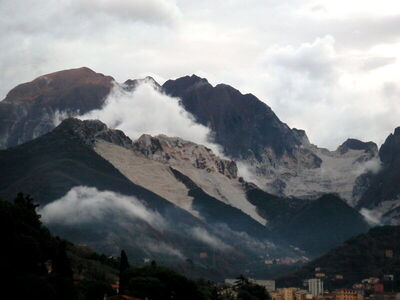
For hiking, the main attraction for most on the mountain and enjoyable through much of the year, the west face is likely the more pleasant option as it is more gentle and grassy and has two of the easiest routes to the summit. At the base you can also spot the marble basin of Foce di Pianza and other impressive, though inactive quarries. There are several other different routes and loops to choose from on, and around, Monte Sagro and your choice will depend on how long you want to spend hiking, your own level of fitness and experience, the members in your party, and what you want to see along the way. One of the other more popular routes to the summit is a three hour round-trip that starts at Foce di Pianza (MSL 1280) and runs south-east, following the signs for CAI trail 172 to Foce della Faggiola and running the entire crest surrounding the Cave del Sagro. From there you continue towards the peak on another, unnumbered trail, which boasts amazing views from the Pizzo d’Uccello over the town of Vinca and its valleys. Then you take the same path back to Foce di Pianza.
Once you get to the summit itself you will find that it is sharp and not very spacious as a result and is surmounted by a giant cross. From here you can take in the most extraordinary views and, on clear days, you can see towards the Gulf of La Spezia and the Versilian Coast, most of the the Ligurian Apennines, other famous peaks in the Alpi Apuane (including Pizzo d'Uccello, Pisanino, Cavallo, Tambura, Sella, Sumbra, and Monte Grondilice, among others), a large part of the Tuscan-Emilian ridge from Monte Orsaro to the Cusna and Prado mountains, the small plain coastal of the Magra River and the eastern Ligurian Sea, and a direct view over Carrara. For one of the most rewarding views in all of Tuscany, be sure to find a vacation rental in Carrara and come hike the stunning Monte Sagro!
Once you get to the summit itself you will find that it is sharp and not very spacious as a result and is surmounted by a giant cross. From here you can take in the most extraordinary views and, on clear days, you can see towards the Gulf of La Spezia and the Versilian Coast, most of the the Ligurian Apennines, other famous peaks in the Alpi Apuane (including Pizzo d'Uccello, Pisanino, Cavallo, Tambura, Sella, Sumbra, and Monte Grondilice, among others), a large part of the Tuscan-Emilian ridge from Monte Orsaro to the Cusna and Prado mountains, the small plain coastal of the Magra River and the eastern Ligurian Sea, and a direct view over Carrara. For one of the most rewarding views in all of Tuscany, be sure to find a vacation rental in Carrara and come hike the stunning Monte Sagro!
Photo credits
Picture 2: Sandra Ross / CC BY 4.0;
Picture 3: Emaalt / CC BY-SA 3.0
Picture 2: Sandra Ross / CC BY 4.0;
Picture 3: Emaalt / CC BY-SA 3.0