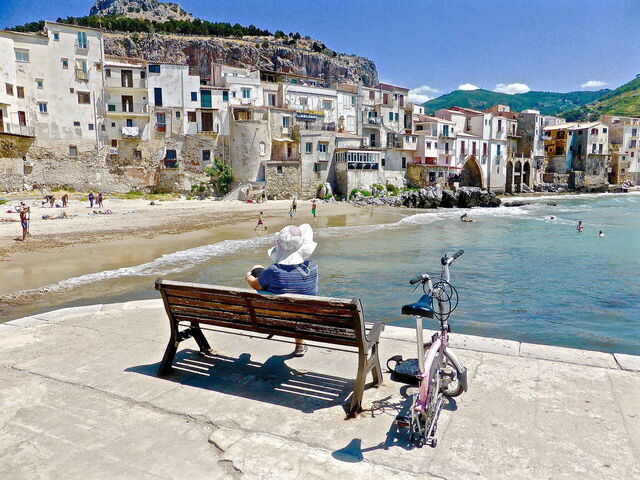
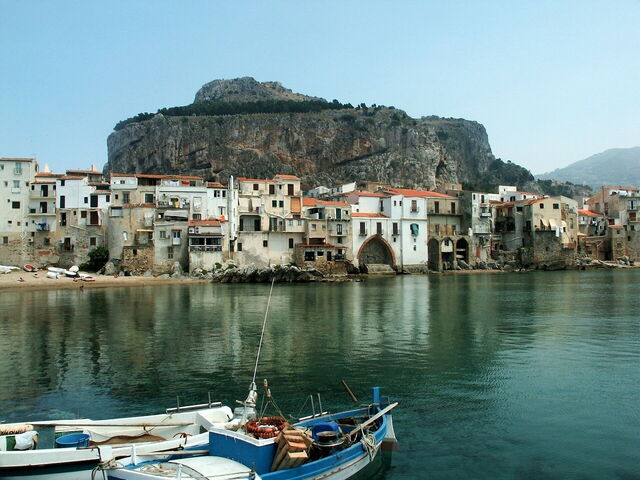
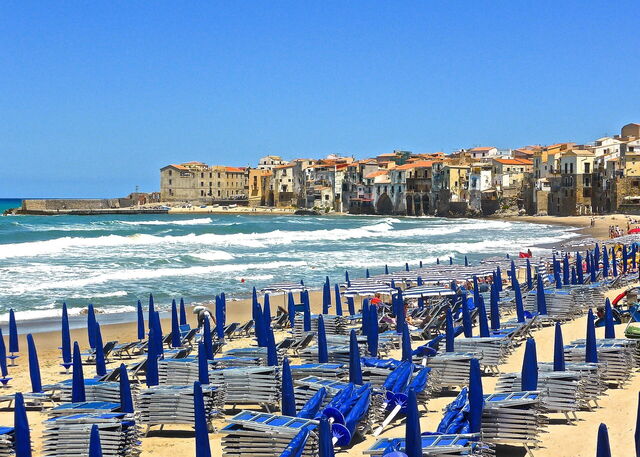
Cefalù must be one of Italy's most beautiful seaside towns. It boasts incredible beaches, beautiful Arab-Norman architectural gems and a wonderful scenic setting amongst rocky outcrops and lush greenery. Furthermore, it presents a dreamy palette of honey-coloured stone facades, terracotta roofs, golden beaches and gilded church interiors, rich blue waters and skies, and vibrant greenery.
No wonder, then, that director Giuseppe Tornatore chose it as a location for scenes in his famous and beloved film, “Cinema Paradiso”; it really is like a slice of paradise. If you want to experience it for yourself, just find a vacation rental in Cefalù.
The perfect spot to get well and truly get away from it all, the pace of life is slow, ideal for wandering around and just enjoying yourself. You can simply take in the harbour, with its bobbing brightly coloured boats, hang out on the sandy beaches, get lost in the winding Mediaeval streets, pop into the little shops located all over or you can check out some of the city's various attractions.
No wonder, then, that director Giuseppe Tornatore chose it as a location for scenes in his famous and beloved film, “Cinema Paradiso”; it really is like a slice of paradise. If you want to experience it for yourself, just find a vacation rental in Cefalù.
The perfect spot to get well and truly get away from it all, the pace of life is slow, ideal for wandering around and just enjoying yourself. You can simply take in the harbour, with its bobbing brightly coloured boats, hang out on the sandy beaches, get lost in the winding Mediaeval streets, pop into the little shops located all over or you can check out some of the city's various attractions.
With origins dating back to at least Greek times but visually reflecting the rule of the Norman King, Roger II, the Cathedral was begun in 1131 and is the crowning gem of the town. Raised, it looks out over the town and bay and has a charming facade that combines Romanesque decorative motifs and zirid and hammadid fortress-palaces typical of the Maghreb. This is Sicilian Romanesque and reflects the Islamic architects who were involved in its construction. Inside, the building is equally stunning, though even more ornate; boasting golden walls, colourful Byzantine mosaics including the amazing Christ Pantocrator, a decorative wooden cross attributed to Guglielmo da Pesaro, carved capitals and a Romanesque font.
The massive crag that towers above the town is called the Rocca and it is worth climbing for the views and the ruins of the so-called Temple of Diana, an ancient megalithic stone structure, at the top. Don't attempt it in hot weather but, should the day suit, climb to the top, breath in the surroundings and wander along the edge of the summit, where the are various other ruins scattered.
The massive crag that towers above the town is called the Rocca and it is worth climbing for the views and the ruins of the so-called Temple of Diana, an ancient megalithic stone structure, at the top. Don't attempt it in hot weather but, should the day suit, climb to the top, breath in the surroundings and wander along the edge of the summit, where the are various other ruins scattered.
Back in town, there is a museum called Museo Mandralisca, which is not especially large but is home to some special gems like a portrait by the famed Early Renaissance artist Antonello da Messina, and the Osterio Magno, the remains of a 13th century palace.
With plenty to do and plenty of nothing at all to do, Cefalù really is the ideal holiday destination in Sicily.
With plenty to do and plenty of nothing at all to do, Cefalù really is the ideal holiday destination in Sicily.