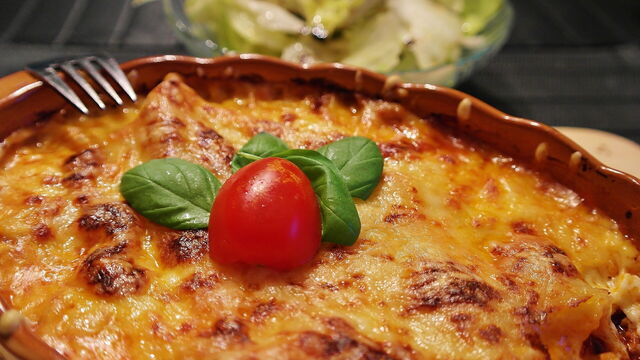
It looks like lasagna but it isn't lasagna; at least not in name. Vincisgrassi is a typical dish, and one of the most eaten regional dishes, of the Le Marche region of Italy and while it is very similar to lasagna: don't call it that! Vincisgrassi has its own distinct history and is an important symbol of Le Marche cuisine together. There are countless variations from all over the region and from household to household but, no matter what variation you manage to get your hands on, if you have found a vacation rental in Le Marche and are exploring this scenic and fascinating region, you cannot leave without tasting a portion of Vincisgrassi! Like a lasagna but richer and with more ingredients, it is the perfect comfort food to give you the energy to traverse the region.
The origins of the dish are, however, swamped in a bit of mystery. There are two legends about how it was created and both are passionately disputed to this day. The first story actually also has two versions, both of which date back to the period of Napoleonic rule, when the region had been taken over by Napoleon's troops.
The origins of the dish are, however, swamped in a bit of mystery. There are two legends about how it was created and both are passionately disputed to this day. The first story actually also has two versions, both of which date back to the period of Napoleonic rule, when the region had been taken over by Napoleon's troops.
Among the soldiers defending the city of Ancona from the occupying Napoleon’s troops was an Austrian general called Windisch Graetz. He did so with such passion and zeal that a chef created the dish based on one that the general liked and dedicated to him.
In another version of the tale of Windisch Graetze, he stopped at a farm house when he was tired and hungry and asked for food. The woman of the house wanted to make him something rich and satisfying and cooked a tomato sauce with left-overs of meat. The general was so impressed that he ordered to his chef to prepare the same dish afterwards and, so, it became a popular meal.
According to the second legend, however, the dish was actually first mentioned in a cook book written by Antonio Nebbia in 1779. The book, entitled “Il cuoco maceratese” (“The chef from Macerata”), mentions a recipe for preparing the “princisgras” (“grease of princes”) sauce. The similarity of the two dishes and names has lead some to speculate that Nebbia was, in fact, the inventor of the dish particularly as Nebbia wrote the very first cookbook that was used throughout Italy.
The second tale is the more likely of the two but no matter which is true, it remains certain that this dish is a must for anyone visiting Le Marche. Check out a recipe, here, if you want to try it for yourself.
In another version of the tale of Windisch Graetze, he stopped at a farm house when he was tired and hungry and asked for food. The woman of the house wanted to make him something rich and satisfying and cooked a tomato sauce with left-overs of meat. The general was so impressed that he ordered to his chef to prepare the same dish afterwards and, so, it became a popular meal.
According to the second legend, however, the dish was actually first mentioned in a cook book written by Antonio Nebbia in 1779. The book, entitled “Il cuoco maceratese” (“The chef from Macerata”), mentions a recipe for preparing the “princisgras” (“grease of princes”) sauce. The similarity of the two dishes and names has lead some to speculate that Nebbia was, in fact, the inventor of the dish particularly as Nebbia wrote the very first cookbook that was used throughout Italy.
The second tale is the more likely of the two but no matter which is true, it remains certain that this dish is a must for anyone visiting Le Marche. Check out a recipe, here, if you want to try it for yourself.