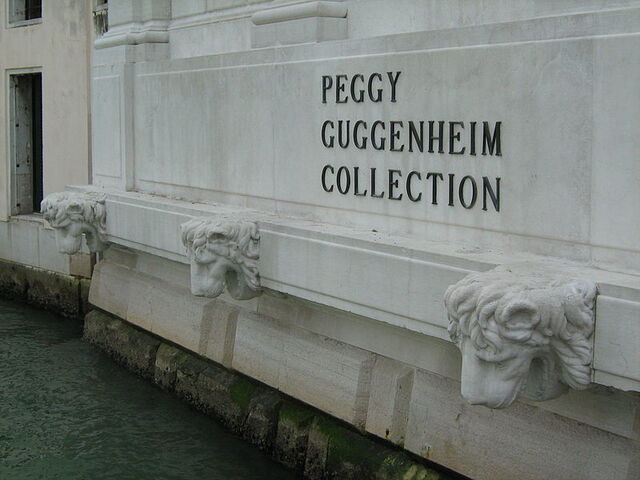
Peggy Guggenheim's life and career are key to the history of 20th century art and she dedicated half of her life to protecting the art of her time. Today, one of Venice's best museums bears her name. It is based on the collection she established and, eventually, began to open to the public seasonally. She was ahead of her time in her attitudes towards collecting art, and to life and left behind an extraordinary tale and a fantastic museum for Venice. The museum is, of course, a must for art-lovers visiting the city once they have found a holiday rental in Venice. However, it will also be of interest to those taken in by fascinating characters from history as Peggy was exactly that; fascinating.
Peggy Guggenheim was born in New York on 26 August 1898, her father was from a family that had acquired a great fortune in the late 19th century while her mother was from a leading banking family. Peggy, an heiress, grew up in New York and socialised in intellectual and artistic circles. Her first husband, Laurence Vail, was a writer and Dada collagist. In the 1920s, they moved to Europe and Peggy found herself at the heart of Parisian bohème. Here she met the likes of Constantin Brancusi, Djuna Barnes and Marcel Duchamp, who were to become lifelong friends. In 1938, at 30 years of age, she opened her Guggenheim Jeune art gallery in London and began a career which would significantly affect the course of post-war art.
Samuel Beckett, a close friend, urged her to dedicate herself to contemporary art as it was “a living thing,” and Duchamp introduced her to the artists. By 1939, she had tired of her gallery and opened a modern museum with her friend Herbert Read as its director. She built the collection for the museum, buying “a picture a day” by the likes of Georges Braque, Salvador Dalí and Piet Mondrian. In 1941, she left Nazi-occupied France and returned to New York, opening what soon became the most stimulating venue for contemporary art in New York City the next year. This collection became the basis of much of what we see today in Venice with works by Robert Motherwell, Mark Rothko, David Hare, Janet Sobel, Robert de Niro Sr, and Jackson Pollock, the ‘star’ of the gallery, who was given his first show in 1943. Peggy and her collection played a vital role in the development of America’s first art movement of international importance.
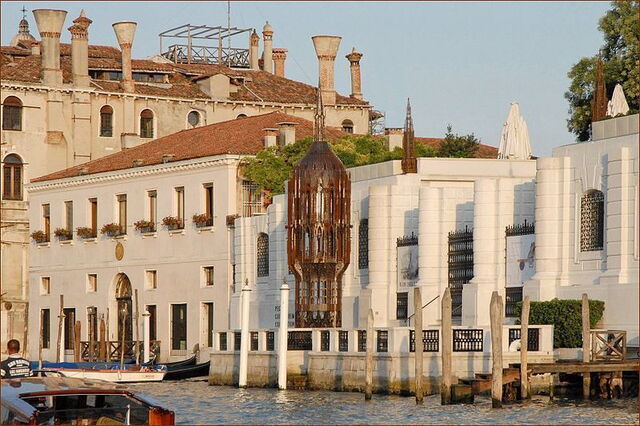
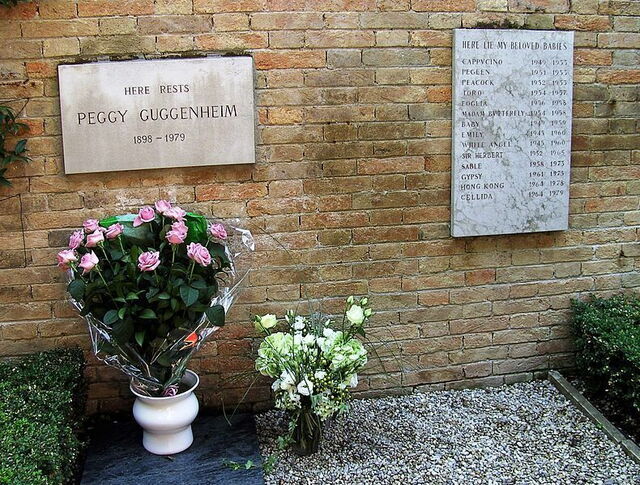
She returned to Europe in 1947, showing her collection at the 1948 Venice Biennale and putting artists such as Arshile Gorky, Jackson Pollock, and Mark Rothko on display across the Atlantic for the first time. She then bought Palazzo Venier dei Leoni, on the Grand Canal in Venice and from 1951 she opened her collection seasonally to the public. In 1976 she donated her palace and works of art to the Solomon R. Guggenheim Foundation and she died in 1979. Her ashes are placed in a corner of the garden of Palazzo Venier dei Leoni and since then Guggenheim Foundation has converted and expanded the building into one of the finest small museums of modern art in the world.
With so much to say, we shall leave it to a second post to discuss the museum itself and why it is one of the highlights of Venice.
She returned to Europe in 1947, showing her collection at the 1948 Venice Biennale and putting artists such as Arshile Gorky, Jackson Pollock, and Mark Rothko on display across the Atlantic for the first time. She then bought Palazzo Venier dei Leoni, on the Grand Canal in Venice and from 1951 she opened her collection seasonally to the public. In 1976 she donated her palace and works of art to the Solomon R. Guggenheim Foundation and she died in 1979. Her ashes are placed in a corner of the garden of Palazzo Venier dei Leoni and since then Guggenheim Foundation has converted and expanded the building into one of the finest small museums of modern art in the world.
With so much to say, we shall leave it to a second post to discuss the museum itself and why it is one of the highlights of Venice.
Photo credit
Picture 1: BKP / CC BY-SA 3.0;
Picture 2: Jean-Pierre Dalbéra / CC BY-SA 2.0;
Picture 3: High Contrast / CC BY-SA 3.0
Picture 1: BKP / CC BY-SA 3.0;
Picture 2: Jean-Pierre Dalbéra / CC BY-SA 2.0;
Picture 3: High Contrast / CC BY-SA 3.0