One of the best parts about holidaying in Italy is trying its cuisine in between bouts of dashing around museums, taking in the landscapes, admiring the buildings and artworks, learning about the history, shopping the boutiques, wandering the markets and venturing through its beautiful streets. Every single town and region has its unique dishes to try and it would take several lifetimes just to put a dent in the long list of delicious dishes. In saying that, we suggest you persevere and try and make even a little dent in that list. Friuli Venezia Giulia is a region, in particular, with an interesting cuisine, inspired by neighbouring nations, its mountainous terrain and harsh winters. Once you've found the best possible vacation rental in Friuli Venezia Giulia, we suggest that you try pitina, a traditional cold cut from the region.
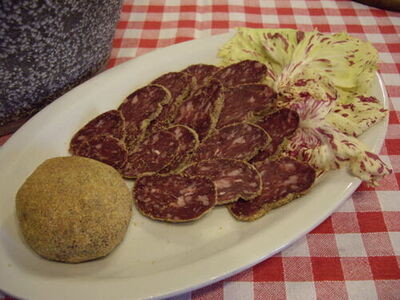
Pitina is an Italian cold cut which originates in the mountain valleys of Tramonti di Sopra and River Cellina of the province of Pordenone in north-eastern Italy. Often categorised as a sausage, it is not a true sausage but, rather, a meatball made of smoked meats. It is thought to have been a 19th century peasant invention, designed to preserve meat in the autumn and winter in traditionally poor areas like the aforementioned valleys north of the city of Pordenone. The preparation method did not require specialized equipment making it available to all homes, even the most isolated mountain huts.
Today, this tradition remains alive and kicking and pitina is even being produced commercially by several families of the area.
Today, this tradition remains alive and kicking and pitina is even being produced commercially by several families of the area.
If a chamois (goat) or roe deer was killed, or a sheep or a goat was sick or wounded and had to be slaughtered, it was essential not to waste any of the meat. The animal would be deboned and its meat finely minced, then pitina were made to preserve it. To make pitina, the meat is mashed with a knife and a paste of garlic. Salt, pepper and red wine is added. The mixture is blended in a mortar and then formed into meatballs. Next, it is rolled in yellow corn (polenta) flour and then left to smoke for several days over a low fire of juniper wood, a typical valley fireplace known as “fogher”. These days, pitina is refined by adding a proportion of pork fat, which softens the intense, gamey flavor of the venison, goat or mutton. It is aged for at least 30 days, then eaten raw or in slices but is also excellent when cooked.
Unknown for a long time outside the region, pitina was at risk of disappearing, with fewer and fewer producers making it. Two artisans who produced pitina in the traditional way, were brought together to preserve the process of making this dish and they are now working to promote it in local restaurants and to expand the market. The festival of Pitina in Tramonti di Sopra has contributed to popularising this speciality outside the region and it is a must-try for those visiting Friuli Venezia Giulia, tasting like smoky salami.
Unknown for a long time outside the region, pitina was at risk of disappearing, with fewer and fewer producers making it. Two artisans who produced pitina in the traditional way, were brought together to preserve the process of making this dish and they are now working to promote it in local restaurants and to expand the market. The festival of Pitina in Tramonti di Sopra has contributed to popularising this speciality outside the region and it is a must-try for those visiting Friuli Venezia Giulia, tasting like smoky salami.
Photo credit: Protramonti / CC BY-SA 3.0