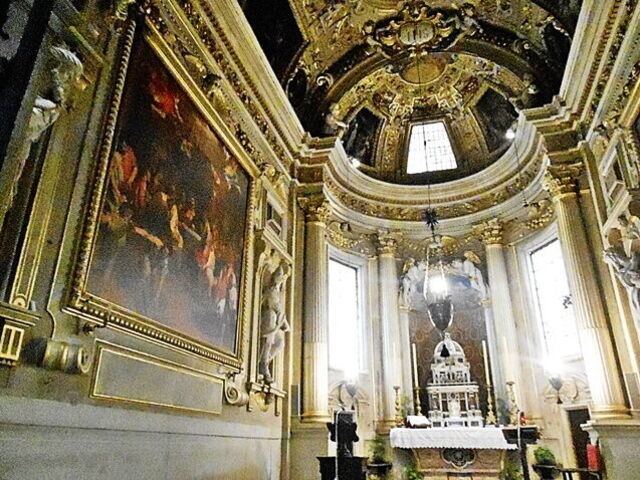
If you are visiting Urbino and have already stopped by the Palazzo Ducale to see the National Museum and palace itself, then you might think about taking a few moments to stop at the Duomo, or cathedral, just next door. Both buildings are part of Urbino's UNESCO heritage and were at the centre of the urban renewal of the beautiful city by the ducal family in the Renaissance, though the cathedral was altered in the 18th century and now bears a neoclassical edifice instead. The Duomo is the perfect complement to a visit to the palace as many of the same artists and designers who worked in the palace also lent their skills to the redesign of the church.
Find a villa with pool in Le Marche and you can spend a day in Urbino discovering these architectural gems for yourself.
Urbino Cathedral, located on the Northern side of Piazza Duca Federico, was built by Bishop Mainardo in 1063 in honor of the Assumption of the Virgin Mary and to replace an earlier structure outside of the city walls. It was rebuilt in the fifteenth century under Federico da Montefeltro and by Francesco di Giorgio Martini and then again at the end of the eighteenth century, when it then took on its definitive neoclassical appearance.
Urbino Cathedral, located on the Northern side of Piazza Duca Federico, was built by Bishop Mainardo in 1063 in honor of the Assumption of the Virgin Mary and to replace an earlier structure outside of the city walls. It was rebuilt in the fifteenth century under Federico da Montefeltro and by Francesco di Giorgio Martini and then again at the end of the eighteenth century, when it then took on its definitive neoclassical appearance.
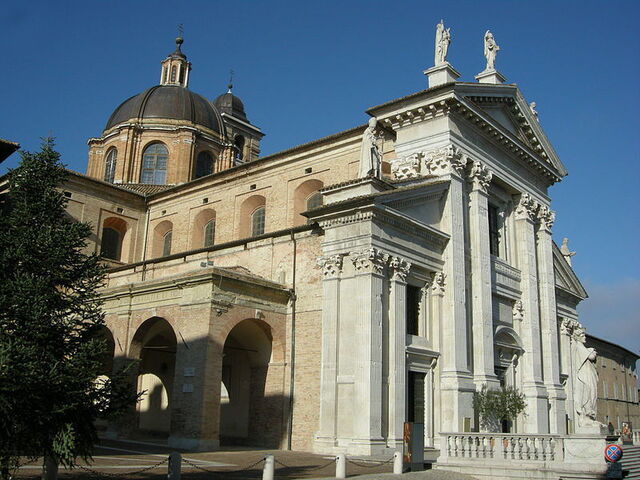
Its majestic and sombre classicising stone-faced façade immediately stands out in sharp contrast among the rich brick of the surrounding buildings and the bell tower and captures your attention.
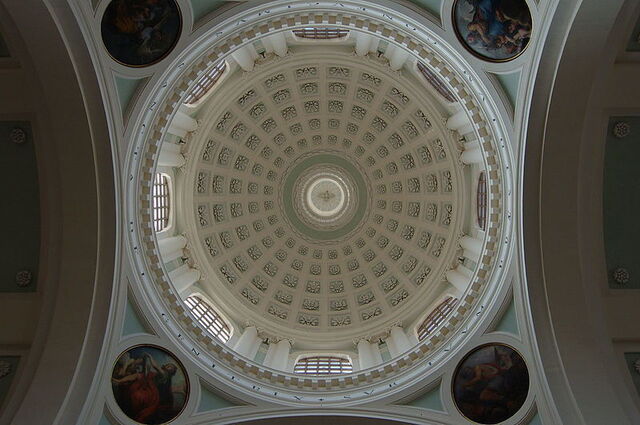
The dome was designed in Muzio Oddi and built after 1604. In 1781, an earthquake damaged both the dome and still incomplete façade. Restoration works proceeded slowly and dome collapsed in 1789. Due to this, the architect Giuseppe Valadier was brought in at the end of the 18th century to rebuild and work was finally completed in 1801. The façade, made of stones from the nearby Furlo mountains, is the work of Camillo Morigia from Ravenna.
Very little of the previous Renaissance church survives, just the Sacrament Chapel, and almost nothing remains of the 11th century building.
The interior displays the neoclassical attitude of Valadier quite clearly with a grand and imposing plan, featuring a structure framing a wide, noble space. The plam is divided into three naves, with bronze statues by Camillo Rusconi in the altar at the end of the central nave. There are also several paintings by named artists which decorate the interior by the likes of Claudio Ridolfi, Federico Barocci (who contributed to the design of the palace's interior) and Raphael Motta. By the major altar there is the large painting by C. Unterberger of the Assumption of the Virgin, recalling the dedication of the building.
With a uniquely rich art collection still surviving on site and a grand classical interior and exterior, the cathedral at Urbino is a rather impressive building and an astounding sight, be sure to pay a visit on your next trip to Le Marche!
The dome was designed in Muzio Oddi and built after 1604. In 1781, an earthquake damaged both the dome and still incomplete façade. Restoration works proceeded slowly and dome collapsed in 1789. Due to this, the architect Giuseppe Valadier was brought in at the end of the 18th century to rebuild and work was finally completed in 1801. The façade, made of stones from the nearby Furlo mountains, is the work of Camillo Morigia from Ravenna.
Very little of the previous Renaissance church survives, just the Sacrament Chapel, and almost nothing remains of the 11th century building.
The interior displays the neoclassical attitude of Valadier quite clearly with a grand and imposing plan, featuring a structure framing a wide, noble space. The plam is divided into three naves, with bronze statues by Camillo Rusconi in the altar at the end of the central nave. There are also several paintings by named artists which decorate the interior by the likes of Claudio Ridolfi, Federico Barocci (who contributed to the design of the palace's interior) and Raphael Motta. By the major altar there is the large painting by C. Unterberger of the Assumption of the Virgin, recalling the dedication of the building.
With a uniquely rich art collection still surviving on site and a grand classical interior and exterior, the cathedral at Urbino is a rather impressive building and an astounding sight, be sure to pay a visit on your next trip to Le Marche!
Photo credits
picture 1: Tuscanycalling / CC BY-SA 3.0;
picture 2: Francesco Gasparetti / CC BY 2.0;
picture 3: Sailko / CC BY-SA 3.0
picture 1: Tuscanycalling / CC BY-SA 3.0;
picture 2: Francesco Gasparetti / CC BY 2.0;
picture 3: Sailko / CC BY-SA 3.0