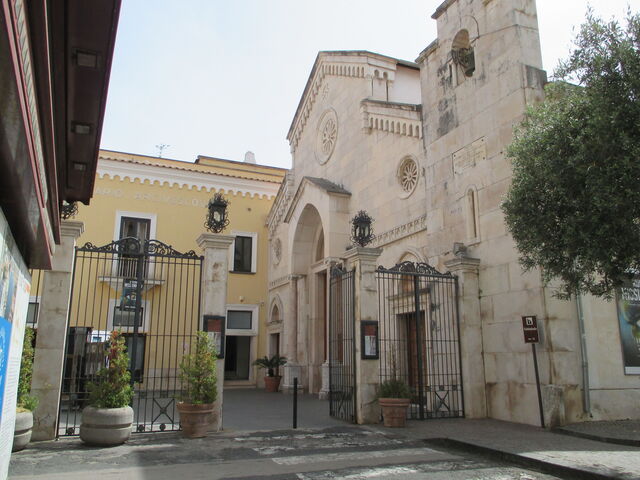
Sorrento Cathedral was built in the 11th century and then rebuilt in the early fifteenth century in the Romanesque style. Since then there have been multiple bouts of rebuilding and restoration up to 1924 when the entire façade was rebuilt. It is located in the centre of this beautiful seaside town, near the main street, Corso Italia. Open daily and free to visit (though donations for the upkeep of the church are welcomed and encouraged) it is an exceptionally lovely Italian cathedral which offers a moment of quiet reflection during your trip as well as representing several different periods in the history of Italy's art and architecture. Find a villa with pool in Sorrento and wile away days wandering the coastline, exploring the city and seeing the sights!
Upon approach, the exterior of the cathedral does not represent its interior well – whitewashed and rather restrained, it does not hint at the colourful and richly detailed décor inside the building.
Furthermore, the building is just to the side of the road and flanked by the bishop's palace, without a large piazza in front, minimising the immediate impact that it has on the visitor.
However, it is still a pretty little façade, even if it does not suggest grandeur. Tripartite with a central nave flanked by lower side-aisles, the facade features a small portico above the main, central entrance and three stained glass rosettes, one over the centre and one over each aisle entrance.
Furthermore, the building is just to the side of the road and flanked by the bishop's palace, without a large piazza in front, minimising the immediate impact that it has on the visitor.
However, it is still a pretty little façade, even if it does not suggest grandeur. Tripartite with a central nave flanked by lower side-aisles, the facade features a small portico above the main, central entrance and three stained glass rosettes, one over the centre and one over each aisle entrance.
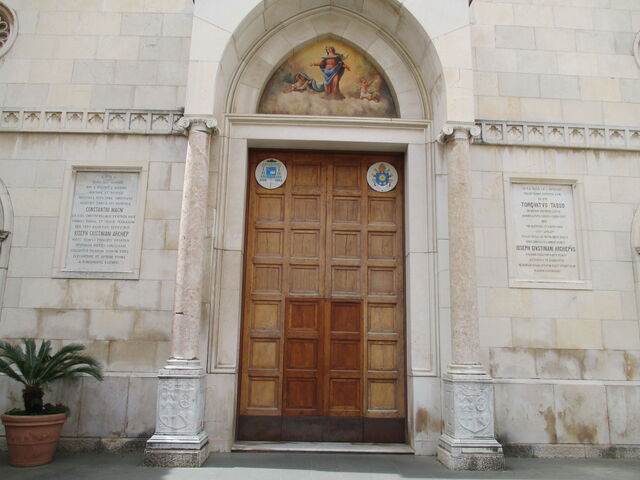
The cathedral was originally quite a small church, as the interior might suggest, but it was later rebuilt by Archbishop Falangola and significantly enlarged. When the bishop's seat was established, it rose to cathedral status. It was also after an invasion by the Turks in 1558, that the grand interior became that which we see today and was redecorated in the Baroque style.
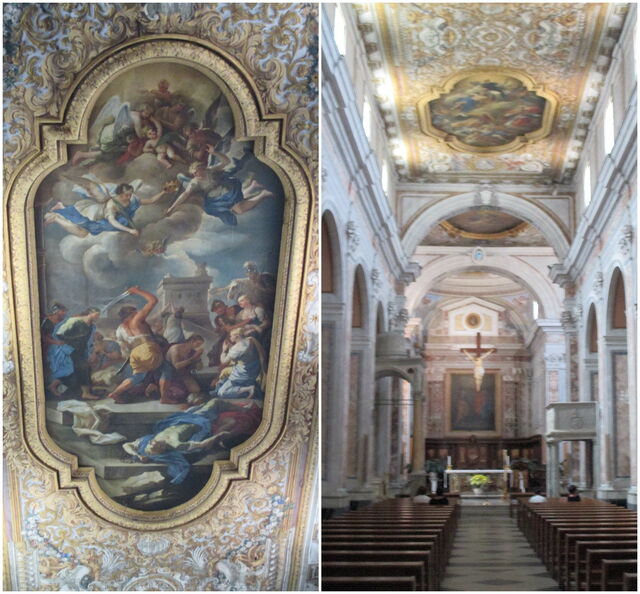
This interior is stunning. There are arches covered with majolica, the best marble in works such as the archbishop's throne, amazing frescoes by the Neapolitan school of the 17th century and quite a lot of wooden marquetry works by local artisans such as the pictures of Via Crucis or the wooden panels of both main and side doors.
On the ceiling is a wonderful painting by Giacomo del Po, a Baroque artist born in Palermo, from around 1700. The choir is a masterpiece of Sorrentine wood inlay. Airy and polychromatic with countless traditional works of art unique to the area, it's a building to get lost in, staring around in awe.
The Cathedral is open daily, from 8am to 12.30 pm and from 4.30 pm to 9pm but there are no tourist visits allowed during liturgical celebrations. Photography is not allowed inside the building so it really needs to be experienced first-hand and, thankfully, really won't let you down! Anyone visiting Campania should make a point to visit this little gem in Sorrento.
This interior is stunning. There are arches covered with majolica, the best marble in works such as the archbishop's throne, amazing frescoes by the Neapolitan school of the 17th century and quite a lot of wooden marquetry works by local artisans such as the pictures of Via Crucis or the wooden panels of both main and side doors.
On the ceiling is a wonderful painting by Giacomo del Po, a Baroque artist born in Palermo, from around 1700. The choir is a masterpiece of Sorrentine wood inlay. Airy and polychromatic with countless traditional works of art unique to the area, it's a building to get lost in, staring around in awe.
The Cathedral is open daily, from 8am to 12.30 pm and from 4.30 pm to 9pm but there are no tourist visits allowed during liturgical celebrations. Photography is not allowed inside the building so it really needs to be experienced first-hand and, thankfully, really won't let you down! Anyone visiting Campania should make a point to visit this little gem in Sorrento.