This article began as a recipe. However, research made it apparent that this is a dish that only the most talented of bakers should attempt, lest the be completely bested and frustrated by the undertaking at hand. It is, of course, possible to make sfogliatelle at home but your best bet to enjoy this delicious pastry is just to find a vacation rental in Naples and pop into a bakery in the morning where you'll find the Neapolitan delight fresh, perfect and probably still warm from the oven! Sounds much more enjoyable than potentially fruitless slaving away in the kitchen, right?
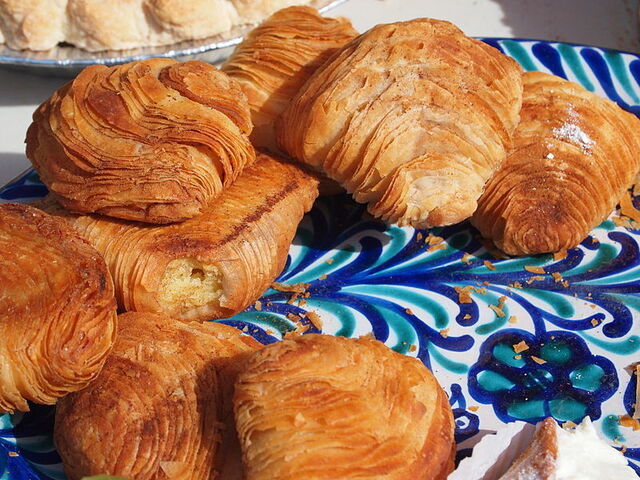
Sfogliatelle are shell-shaped filled pastries and the name means “small, thin leaf/layer” as the texture of the dish closely resembles leaves stacked on upon another. The treat has many origin stories but the most popular states that it originates from Salerno and was invented in the 17th century in the monastery of Santa Rosa in Conca dei Marini. In the nineteenth century, however, the original recipe was acquired by Pasquale Pintauro, a pastry chef from Naples who began producing and selling the pastries in his shop. It was then popularised and there are now plenty of regional variations to be discovered in various parts of Italy and, even, America. Naples, remains, arguably, the best place to try sfogliatelle.
It is the intricacy of the production of the pastry that makes it so difficult and which ensures that the good examples are outstanding, while the bad are utter failures. The dough is first stretched out on a large table or flattened with a Pasta maker, then brushed with fat, then rolled into a log (like a Swiss roll with many more layers). Disks are cut from the end, shaped to form pockets and then filled. It is then baked until the layers separate, forming its characteristic ridges. Patience and experience are key to making the perfect sfogliatella.
As noted, there are many variations of the pastry and there are also great many recipes for the dough and filling. However, some of the most popular fillings that you can come across include orange-flavoured ricotta, almond paste and candied peel of citron. If you are visiting Campania, you need to track this down as the perfect (and tasty) way to kick-start a day exploring the region and its history, culture and customs!
It is the intricacy of the production of the pastry that makes it so difficult and which ensures that the good examples are outstanding, while the bad are utter failures. The dough is first stretched out on a large table or flattened with a Pasta maker, then brushed with fat, then rolled into a log (like a Swiss roll with many more layers). Disks are cut from the end, shaped to form pockets and then filled. It is then baked until the layers separate, forming its characteristic ridges. Patience and experience are key to making the perfect sfogliatella.
As noted, there are many variations of the pastry and there are also great many recipes for the dough and filling. However, some of the most popular fillings that you can come across include orange-flavoured ricotta, almond paste and candied peel of citron. If you are visiting Campania, you need to track this down as the perfect (and tasty) way to kick-start a day exploring the region and its history, culture and customs!
Photo credit: orchidgalore / CC BY 2.0