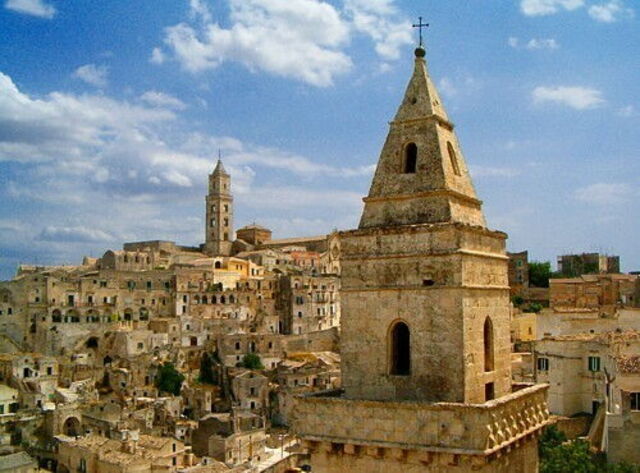
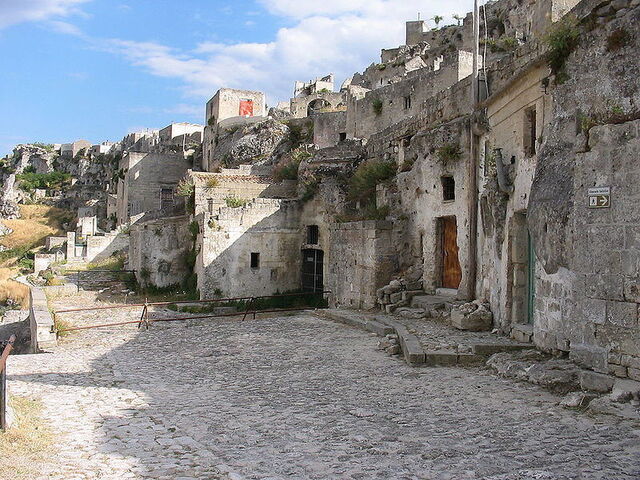
Regional breads abound across the length and breadth of Italy, however, the most famous of these is probably the bread of Matera in Basilicata, Italy. A stunning southern Italian town, Matera is one of the oldest inhabited cities in the world and its historic centre, the “Sassi” (ancient cave dwellings), is a UNESCO Heritage Site. The town is within a canyon carved out by the Gravina and is extraordinarily beautiful and unique. If not for the town itself, you must make sure to visit in order to taste the local cuisine!
Find a holiday rental in Basilicata and spend time exploring the town, both old and new, and eating all the regional treats.
Find a holiday rental in Basilicata and spend time exploring the town, both old and new, and eating all the regional treats.
The Pane di Matera, or Matera bread, is an IGP, an internationally recognised protected regional speciality. Made according to best practice, only 100% Lucanian milled semolina grain, called “Senatore Cappelli”, is used. There are strict IGP preparation procedures to ensure the maintaining of high quality and tradition.
Grain must be stored in thermal-ventilated silos to ensure that the organoleptic properties remain unaltered. Other necessities include using natural yeast from the maceration of grapes and figs in water and to leave the dough fermenting over a long period of time in clay cisterns.
Grain must be stored in thermal-ventilated silos to ensure that the organoleptic properties remain unaltered. Other necessities include using natural yeast from the maceration of grapes and figs in water and to leave the dough fermenting over a long period of time in clay cisterns.
Characteristics of this food product include being rather wholesome, use of raw ingredients and artisanal manufacture. However, the most recognisable aspect of the Pane di Matera is probably its appearance. It is lumpy, a-symmetrical and imperfect on the outside but charmingly, authentically so with a rich golden finish. The outside is crisp while the inside is soft without being overly airy.
Until 1950 the wood ovens of the town which were used to bake the bread were shared by all of the inhabitants. In order to differentiate between the bread belonging to each family, they pressed brands into the dough using a wooden stamp.
These stamps can still be seen on display in the National Archaeological Museum of Matera and some bread still remains stamped to this day.
The Pane di Matera is delicious on its own but is often used in local dishes such as ‘cialledda calda,’ a mixture of egg, bay leaves, garlic and olives on hot bread; and ‘cialledda fredda,’ moist bread with tomatoes and garlic.
Matera is also known for its pasta and several wines so between the eating and exploring, you'll never want to leave! Make sure to stop by on your next trip to Basilicata.
Until 1950 the wood ovens of the town which were used to bake the bread were shared by all of the inhabitants. In order to differentiate between the bread belonging to each family, they pressed brands into the dough using a wooden stamp.
These stamps can still be seen on display in the National Archaeological Museum of Matera and some bread still remains stamped to this day.
The Pane di Matera is delicious on its own but is often used in local dishes such as ‘cialledda calda,’ a mixture of egg, bay leaves, garlic and olives on hot bread; and ‘cialledda fredda,’ moist bread with tomatoes and garlic.
Matera is also known for its pasta and several wines so between the eating and exploring, you'll never want to leave! Make sure to stop by on your next trip to Basilicata.
Photo credits
picture 1: Idéfix / CC BY-SA 3.0;
picture 2: vic15 / CC BY 2.0
picture 1: Idéfix / CC BY-SA 3.0;
picture 2: vic15 / CC BY 2.0