
If you’re planning a holiday that passes through the region of Piedmont between 19th April and 24th June 2015 then be sure to visit Turin to gaze upon the mysterious Shroud of Turin!
This rare ‘unveiling’ of the Turin Shroud was announced to commemorate the Bicentenary of John Bosco, an endeared priest of the 1800s.
This opportunity to see a popular ‘icon’ of the Catholic Church would be a fascinating tourist experience as the Turin Shroud is mostly sealed within a special airtight case under the altar of the royal chapel in the duomo.
The Turin Shroud is a long strip of linen cloth that marks the image of a man that bears marks of injury consistent with that of crucifixion. It is believed by many to be the shroud used to wrap Jesus in when he was removed from the cross and laid to rest in a tomb.
This rare ‘unveiling’ of the Turin Shroud was announced to commemorate the Bicentenary of John Bosco, an endeared priest of the 1800s.
This opportunity to see a popular ‘icon’ of the Catholic Church would be a fascinating tourist experience as the Turin Shroud is mostly sealed within a special airtight case under the altar of the royal chapel in the duomo.
The Turin Shroud is a long strip of linen cloth that marks the image of a man that bears marks of injury consistent with that of crucifixion. It is believed by many to be the shroud used to wrap Jesus in when he was removed from the cross and laid to rest in a tomb.
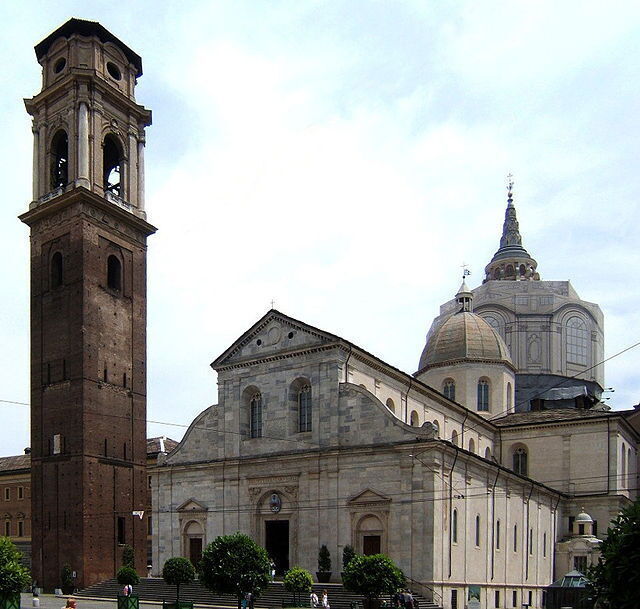
Many scientific tests have been conducted to determine the ages, marks and composition of the cloth but despite all, no definitive conclusions can be made to either prove or disprove its authenticity.
The Shroud of Turin is rectangular in shape, measuring approximately 4.5 by 1 metres. When flattened out it shows the brownish image of a naked man. He would have been laid upon it and the other half was folded over his front.
Marks on the Turin Shroud which are interpreted to correspond with that of Jesus’s crucifixion are large bloody marks on the wrists and feet, puncture wounds on the scalp and forehead and whip marks on the legs and torso to name just a few.
The Shroud of Turin is rectangular in shape, measuring approximately 4.5 by 1 metres. When flattened out it shows the brownish image of a naked man. He would have been laid upon it and the other half was folded over his front.
Marks on the Turin Shroud which are interpreted to correspond with that of Jesus’s crucifixion are large bloody marks on the wrists and feet, puncture wounds on the scalp and forehead and whip marks on the legs and torso to name just a few.
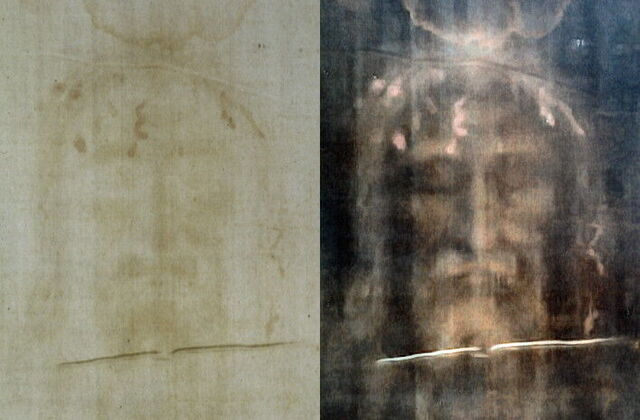
The imprint of the ‘Man of the Turin Shroud’ shows that he was tall and muscular with a beard, moustache and shoulder length hair.
The Turin Shroud is one of the most interesting objects in history and would be a treat to see on your next vacation to Italy!
Book a stunning villa in Piedmont and tour around other mesmerising attractions such as the unusual Lingotto building, Mole Antonelliana building and the Palace of Venaria.
The Turin Shroud is one of the most interesting objects in history and would be a treat to see on your next vacation to Italy!
Book a stunning villa in Piedmont and tour around other mesmerising attractions such as the unusual Lingotto building, Mole Antonelliana building and the Palace of Venaria.
Photo credits
picture 3: Dianelos / CC BY-SA 3.0
picture 3: Dianelos / CC BY-SA 3.0