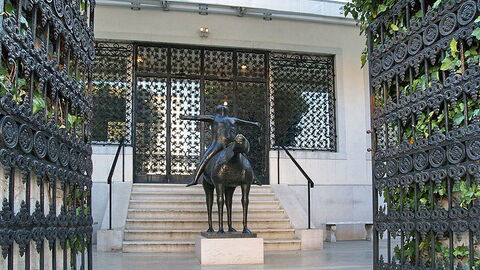
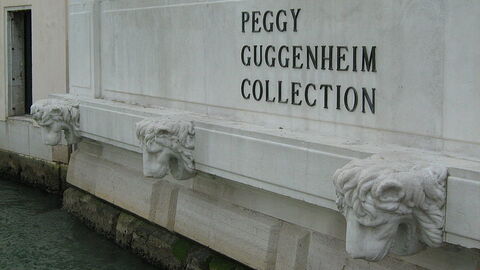
In the previous post, we discussed the fascinating character that was Peggy Guggenheim and mentioned how her career and collection began. Her collection went from a great support to contemporary artists of the 20th century, and a driving force to pushing forward the artistic scene of the time, and private thing of immense beauty and prestige to a leading museum in Venice. In her own lifetime, Guggenheim opened the collection to the public during summer months and, in her final years, donated it to the art foundation established by her uncle and backer of the Guggenheim in New York. It was then converted into a museum and is now open year-round to anyone visiting the beautiful city of Venice. Just find a vacation rental in Venice and you can explore this little artistic gem and all that is held within.
Peggy Guggenheim's life and career are key to the history of 20th century art and she dedicated half of her life to protecting the art of her time. Today, one of Venice's best museums bears her name. It is based on the collection she established and, eventually, began to open to the public seasonally. She was ahead of her time in her attitudes towards collecting art, and to life and left behind an extraordinary tale and a fantastic museum for Venice. The museum is, of course, a must for art-lovers visiting the city once they have found a holiday rental in Venice. However, it will also be of interest to those taken in by fascinating characters from history as Peggy was exactly that; fascinating.
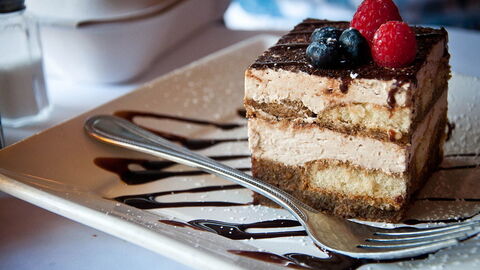
Tiramisu is one of the most famous and beloved of all Italian desserts. As a result, many want to stake their claim to it and its origins have become uncertain. Most accounts, however, attribute the dish to a restaurant called Le Beccherie in Treviso. It is said that it was created by a confectioner named Roberto Linguanotto, owner of the restaurant, and his apprentice, Francesca Valori, whose maiden name was Tiramisu. Yet, one Carminantonio Iannaccone claims that he invented it on the 24th of December in 1969 and was then supplied to Le Beccherie. Other sources, meanwhile, trace the dessert back to 17th century Siena when it was made in honour of the Grand Duke Cosimo III. It is difficult to say which account is true but the dish does not seem to appear in cookbooks before the 1960s. Either way, one of the best places to try it is in Treviso so why not find a vacation rental in Veneto and taste it there?
Built between 1196 and 1307, the pink marble Baptistery of Parma is one of the most distinctive and memorable buildings in the entire city. It is also one of the most highly regarded and well-known of all medieval structures and is a clear example of the transition from Romanesque to Gothic art in Italy. Octagonal in shape, built out of pink Verona marble and standing tall, made of four tiers of open loggias topped by a row of blind arches and crowning pinnacles, it is a striking and impressive building. While the exterior is harmonious and elegant, inside is a riot of colour with painted frescoes and elaborate embellishments. The result is a deeply fascinating building with plenty to take in. If you've found the perfect vacation rental in Emilia Romagna, then be sure to visit Parma and stop by the Baptistery.
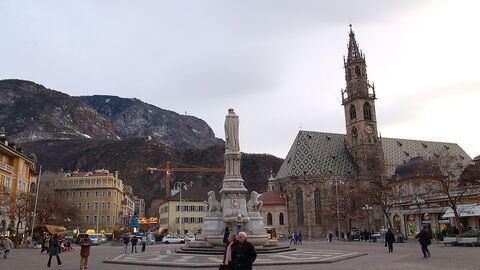
Once you’ve found a vacation rental in Trentino Alto Adige and are planning on visiting the city of Bolzano, make sure to find time to see Ötzi, the 5,000-year-old Iceman and oldest human mummy on earth. Discovered by German tourists in a glacier in the area in 1991, it has been on display in a purpose-built museum since 1998. Ötzi has been the talk of the past years not only in Bolzano, but all over the world and he’s probably the only mummy in the whole world to have an entire museum dedicated just to him. Every year thousands of visitors come to Bolzano just to see him.
The body has been extensively examined, measured, x-rayed, and dated since it has been found and research into the body is on-going to this day. The Archaeology Museum of Bolzano houses the Iceman and also documents the pre-history and early history of the surrounding area from the end of the last Ice Age to the time of Charlemagne. It uses models, reconstructions, stereoscopic images, videos and interactive multimedia stations to provide an interesting, engaging and informative experience. Yet, its main purpose remains to be displaying, housing and researching Ötzi.
How the body is displayed and the museum organised has been very carefully planned. In awareness of fact that the discovery of the body was likely to trigger heated ethical discussions, the careful and restrained presentation of the Iceman was the first and foremost concern when the museum was established in 1998. The current exhibition, as it appears today, is actually the format created for the special 20th anniversary exhibition in 2011. This, however, went on to become the permanent method of display in 2013.
The area surrounding the mummy is stark, made up of white walls that evoke the snow-covered landscape in which it was discovered. Everything surrounding, from fonts to graphics to décor is muted and does not detract from the mummy or sensationalise it. The room is also actually partitioned, meaning those interested in the story but uncomfortable with viewing the body can still enjoy a visit to the museum. The mummy has been placed in a visually separated, tastefully designed room which is kept at a fixed temperature of -6ºC and nearly 100% relative air humidity - the same conditions found in a glacier. The accompanying finds are also kept in acclimatised, nitrogen-filled showcases at a temperature of 18ºC.
Tasteful, fascinating and engaging, this museum is a must for anyone visiting Trentino Alto Adige.
— Colette Fitzpatrick
Loading . . .
Attention
An error has occurred, please contact the Service Administrator.