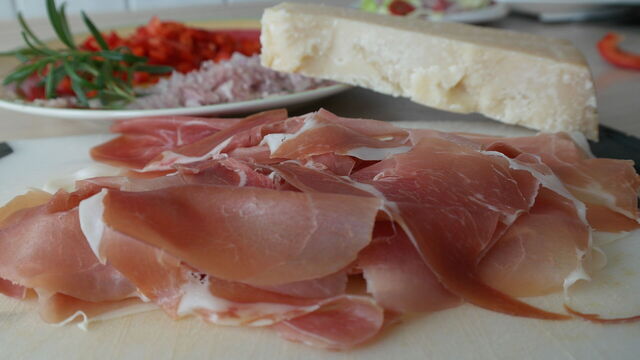
Prosciutto di Parma, or Parma Ham, is, perhaps, Italy's most famous typical food product worldwide. Certainly, it ranks highly amongst the best-known products – alongside the likes of Balsamic Vinegar and Parmesan. It is probably also one of the foods mostly intimately connected with its town of origin, as many are unfamiliar with one without the other; people know Parma Ham but not necessarily Parma and know of Prosciutto di Parma specifically among all cured meats from the country.
It is a time-honored classic exported only from one place in Italy and is famous for its perfect texture and delicious flavour. If you are a serious foodie, it certainly puts Parma on the map and your list of places to visit in Italy. Just find a vacation rental in Emilia Romagna and discover the flavours and delights of the city for yourself!
The history of Prosciutto di Parma dates back to the Roman period. Modern Parma was located at the heart of the Cisalpine Gaul, which was a province of the Roman Republic and it is recorded that the area was known for being particularly skilled in the curing of ham. The process was even described in detail in the 2nd century and it remains largely unchanged to this day. In the Middle Ages, the “art” to getting the prosciutto right was formally acknowledged with the formation of the Arte dei Lardaroli, a salumi-makers guild. Today, it is a DOP food that is officially recognised by the EU and has massive worldwide fame, being exported to countries all over the globe.
Producing prosciutto was once done by hand, but has since been industrialised, improving sanitation while keeping the traditional characteristics of the product. In order to be called Prosciutto di Parma, it must come from pigs raised in a specific area (either Emilia Romagna, Lombardy, Piedmont, Veneto, Tuscany, Umbria, Marche, Lazio, Abruzzo, or Molise) and has to be produced in a precise area in the province of Parma. Why this one area, though? Well, in addition to the history and tradition rooted in the area, it is also recognised for its special microclimate caused by the air that blows up from Versilia; passing through the olive and pine groves of the Val di Magra, drying as it reaches the Apennines and being infused with a scent of chestnut, before arriving in Parma.
Parma ham is made from meat from pigs that are humanely raised, made with only four ingredients (pork, sea salt, Italian air, and time) and is 100% natural. It is delicious and one of Italy's best loved food products. However, there is also much more to Parma and her culinary scene. As a result, it is a must-see town for any foodies thinking of paying a visit to Italy.
The history of Prosciutto di Parma dates back to the Roman period. Modern Parma was located at the heart of the Cisalpine Gaul, which was a province of the Roman Republic and it is recorded that the area was known for being particularly skilled in the curing of ham. The process was even described in detail in the 2nd century and it remains largely unchanged to this day. In the Middle Ages, the “art” to getting the prosciutto right was formally acknowledged with the formation of the Arte dei Lardaroli, a salumi-makers guild. Today, it is a DOP food that is officially recognised by the EU and has massive worldwide fame, being exported to countries all over the globe.
Producing prosciutto was once done by hand, but has since been industrialised, improving sanitation while keeping the traditional characteristics of the product. In order to be called Prosciutto di Parma, it must come from pigs raised in a specific area (either Emilia Romagna, Lombardy, Piedmont, Veneto, Tuscany, Umbria, Marche, Lazio, Abruzzo, or Molise) and has to be produced in a precise area in the province of Parma. Why this one area, though? Well, in addition to the history and tradition rooted in the area, it is also recognised for its special microclimate caused by the air that blows up from Versilia; passing through the olive and pine groves of the Val di Magra, drying as it reaches the Apennines and being infused with a scent of chestnut, before arriving in Parma.
Parma ham is made from meat from pigs that are humanely raised, made with only four ingredients (pork, sea salt, Italian air, and time) and is 100% natural. It is delicious and one of Italy's best loved food products. However, there is also much more to Parma and her culinary scene. As a result, it is a must-see town for any foodies thinking of paying a visit to Italy.