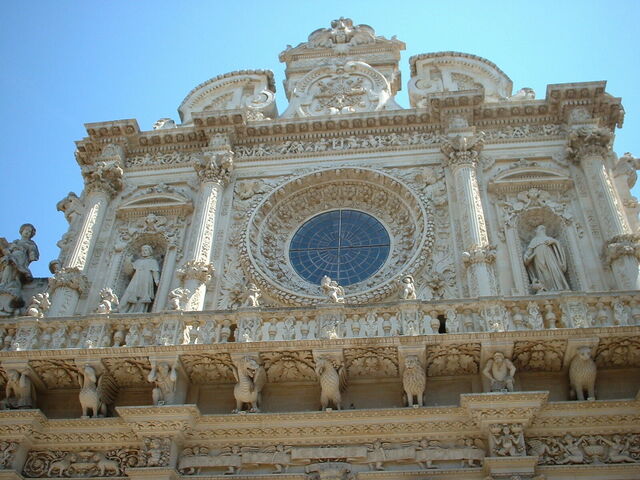
The Basilica di Santa Croce, or Church of the Holy Cross, is one of the oldest and best-known of Lecce's Baroque buildings.
In a stunning city of architectural and cultural gems, it manages to still stand out as one of the most beautiful. Just find a vacation rental in Apulia and you can explore this gem of a destination for yourself.
Work on the basilica began in 1549, as part of the renewal of the area declared by emperor Charles V in response to the threat of an invasion by the Ottoman Turks. The Battle of Lepanto came and went and, all the while, local artisans, architects and artists transformed the city.
The basilica was the work of Gabriele Riccardi, Cesare Penna and Giuseppe Zimbalo and is a grand project that catalogues mythology, religion and history on the interior and exterior.
In a stunning city of architectural and cultural gems, it manages to still stand out as one of the most beautiful. Just find a vacation rental in Apulia and you can explore this gem of a destination for yourself.
Work on the basilica began in 1549, as part of the renewal of the area declared by emperor Charles V in response to the threat of an invasion by the Ottoman Turks. The Battle of Lepanto came and went and, all the while, local artisans, architects and artists transformed the city.
The basilica was the work of Gabriele Riccardi, Cesare Penna and Giuseppe Zimbalo and is a grand project that catalogues mythology, religion and history on the interior and exterior.
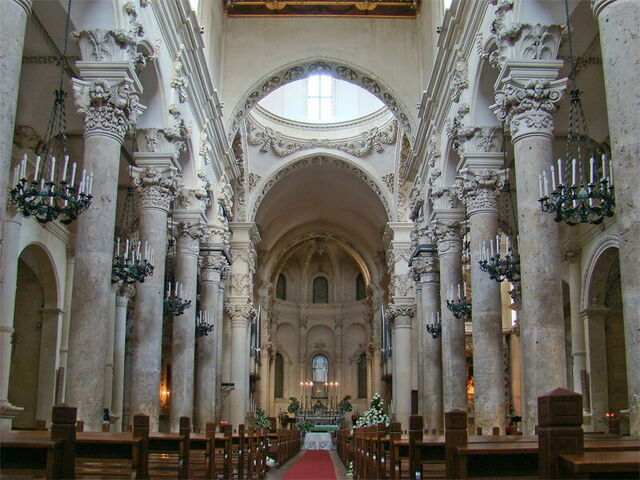
The result is a stunning and dizzying sumptuous allegorical feast for the eyes. Depicted on the exterior, carved from stone are sheep, dodos, cherubs, gargoyles, corbels, festoons, columns and cornices crowded with human figures, flowers and fantastic beasts. The interior, meanwhile, is a little less richly ornamented and more conventional of Renaissance architectural tropes. It has a cross-vaulted roof with a hemispherical cupola on top outside and is divided into three naves. Construction of Santa Croce was completed in 1695.
During the 18th to 19th centuries, the basilica was momentarily abandoned during the suppression of religious orders under Napoleonic rule. Restoration then took place in 1828 and, in 1906, it was declared a national monument. Thankfully, it was not damaged much in WWII and the façade was further restored in the 1980s.
Today it is part of the UNESCO heritage site that is the Baroque architecture of Lecce and is the crowning jewel of the lot.
During the 18th to 19th centuries, the basilica was momentarily abandoned during the suppression of religious orders under Napoleonic rule. Restoration then took place in 1828 and, in 1906, it was declared a national monument. Thankfully, it was not damaged much in WWII and the façade was further restored in the 1980s.
Today it is part of the UNESCO heritage site that is the Baroque architecture of Lecce and is the crowning jewel of the lot.
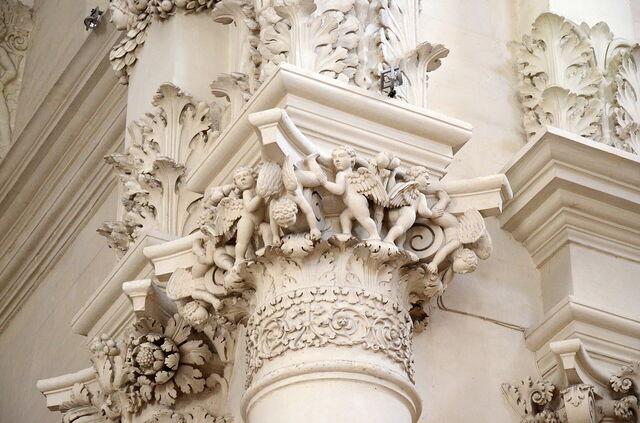
Photo credit
Picture 1: Laibniz / CC BY-SA 3.0;
Picture 2: Tango7174 / CC BY-SA 4.0
Picture 1: Laibniz / CC BY-SA 3.0;
Picture 2: Tango7174 / CC BY-SA 4.0