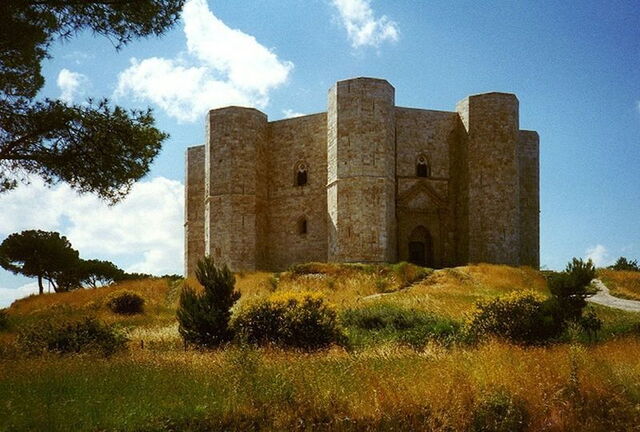
Castel del Monte is probably one of the most memorable castles and buildings that you will ever see. Its distinctive appearance, architectural brilliance and historical importance have meant that it has been designated a UNESCO World Heritage Site (one of 50 in Italy). The building, located in Apulia, near Bari, was commissioned by Frederick II of Swabia in the 13th century and sits on a hilltop, surveying the beautiful surrounding landscape. Whether you're interested in history or not, this sight is well worth a visit for the views that it offers and its dominating octagonal structure which seems like something plucked right from the pages of Game of Thrones or some other grand fantasy novel. Just find a luxury villa in Apulia and head to the castle one day to explore, admire and learn.
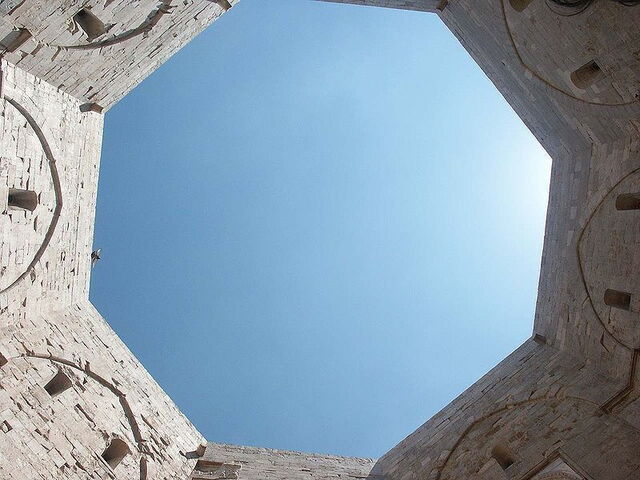
Castel del Monte (literally meaning “Castle on the Mountain”) was built around 1240 to serve as the permanent seat of Frederick II of Hohenstaufen, who had become King of Sicily at just three years of age. Known for being an eclectic and cultured individual, the castle took on the same enigmatic air as its owner. Considered a genius work of medieval architecture, it brings together styles, elements and traditions of different periods from history, with elements influenced by ancient Roman, Gothic, Romanesque and Islamic architecture. However, these elements blend seamlessly together and are somewhat upstaged by the grandeur of the mathematical vigour and perfect symmetry of the Castle's design.
In fact, this is where the true genius lies. Eight is the guiding number (eight façades, eight rooms on ground and second floor, trapezoidal rooms placed to form octagons, eight octagonal towers) and the position of the building was carefully planned to allow for symmetries of light during the winter solstice and summer equinox. The result of all this is a building that is steeped in a symbolism that continues to perplex scholars. In appearance, however, the building looks militaristic and mighty but actually lacks many military elements. There are no outer walls and there is no moat nor stables.
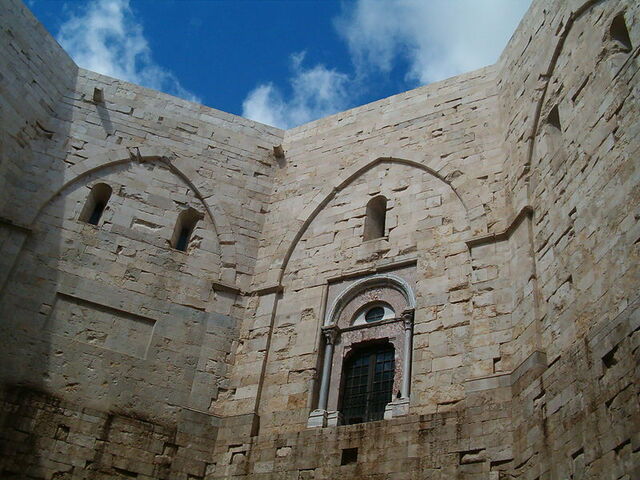
In fact, the castle appears as though everyone was less concerned with defence and more interested in luxury. The panoramic view from the terraces at roof level were a great strategic advantage during the Middle Ages, but are also just a stunning feature of the building. In the past, the grandeur of the building and beauty of the setting were enhanced by the interiors which were decorated with precious polychrome marble, mosaics, paintings and tapestries. Most of the doors are still nicely decorated with coloured marble, but nothing remains of the decor which has been pillaged and destroyed over the years.
The interior is now an empty husk but it is still worth a visit! It's just a pity as one can only imagine what it once was. If you're visiting Apulia, however, don't miss out on this extraordinary building.
In fact, the castle appears as though everyone was less concerned with defence and more interested in luxury. The panoramic view from the terraces at roof level were a great strategic advantage during the Middle Ages, but are also just a stunning feature of the building. In the past, the grandeur of the building and beauty of the setting were enhanced by the interiors which were decorated with precious polychrome marble, mosaics, paintings and tapestries. Most of the doors are still nicely decorated with coloured marble, but nothing remains of the decor which has been pillaged and destroyed over the years.
The interior is now an empty husk but it is still worth a visit! It's just a pity as one can only imagine what it once was. If you're visiting Apulia, however, don't miss out on this extraordinary building.
Photo credits
Picture 2: Marcok / CC BY-SA 2.5;
Picture 3: O.S. / CC BY-SA 3.0
Picture 2: Marcok / CC BY-SA 2.5;
Picture 3: O.S. / CC BY-SA 3.0