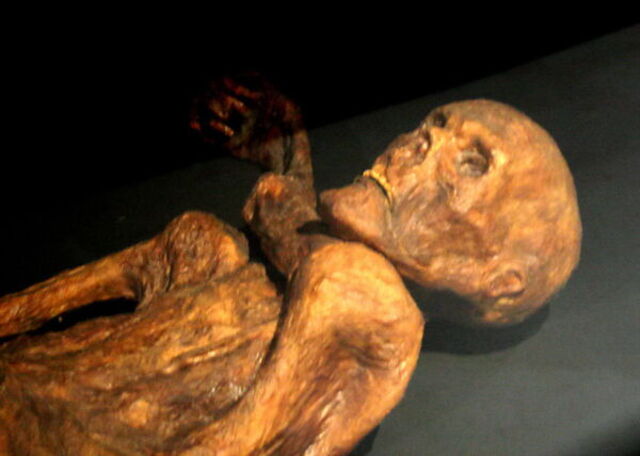
If you’ve found a holiday rental in Trentino Alto Adige and are planning on visiting the city of Bolzano, there’s a very famous gentleman who lives there that you should make sure to pencil in some time to visit. He's over 5,000 years old and has been the talk of the past years not only in Bolzano, but all over the world. His name is Ötzi the Iceman and he’s a mummy. In fact, he’s probably the only mummy in the whole world to have an entire museum dedicated just to him. The Ötzi Museum in Bolzano has been home to the Iceman, the oldest human mummy on earth, since 1998 and every year thousands of visitors come just to see him.
Over 5,000 years ago, a man climbed to the icy heights of the Schnalstal glacier and died there. In 1991 he was found, along with his clothes and other gear, mummified and frozen, by two German tourists, Helmut and Erika Simon. The body was at first thought to be a modern corpse, like several others which had been recently found in the region. It was quickly and hastily retrieved by the Austrian authorities and taken to Innsbruck before true age was finally discovered. Subsequent surveys showed that the body had been located a few meters inside Italian territory and it is now on display at the South Tyrol Museum of Archaeology in Bolzano.
He is Europe's oldest known natural human mummy, and has offered an unprecedented view of Chalcolithic Europeans. The body has been extensively examined, measured, x-rayed, and dated. Tissues and gut contents were examined microscopically, as was the pollen found on his gear. All of this tells us that at the time of his death, Ötzi was a 30-to-45-year old man, approximately 160cm tall and 50kg in weight. More recently, a DNA study conducted by Walther Parson of Innsbruck Medical University revealed Ötzi has 19 living genetic relatives. Research is also on-going with more discovered about Ötzi and more learned from him each year.
In addition to housing the remains of the Iceman, the Archaeology Museum also documents the pre-history and early history of the surrounding area from the end of the last Ice Age to the time of Charlemagne. It uses models, reconstructions, stereoscopic images, videos and interactive multimedia stations to provide an interesting, engaging and informative experience. However, the star of the show is still Ötzi himself who continues to fascinate people and draw them back to Trentino Alto Adige.
Over 5,000 years ago, a man climbed to the icy heights of the Schnalstal glacier and died there. In 1991 he was found, along with his clothes and other gear, mummified and frozen, by two German tourists, Helmut and Erika Simon. The body was at first thought to be a modern corpse, like several others which had been recently found in the region. It was quickly and hastily retrieved by the Austrian authorities and taken to Innsbruck before true age was finally discovered. Subsequent surveys showed that the body had been located a few meters inside Italian territory and it is now on display at the South Tyrol Museum of Archaeology in Bolzano.
He is Europe's oldest known natural human mummy, and has offered an unprecedented view of Chalcolithic Europeans. The body has been extensively examined, measured, x-rayed, and dated. Tissues and gut contents were examined microscopically, as was the pollen found on his gear. All of this tells us that at the time of his death, Ötzi was a 30-to-45-year old man, approximately 160cm tall and 50kg in weight. More recently, a DNA study conducted by Walther Parson of Innsbruck Medical University revealed Ötzi has 19 living genetic relatives. Research is also on-going with more discovered about Ötzi and more learned from him each year.
In addition to housing the remains of the Iceman, the Archaeology Museum also documents the pre-history and early history of the surrounding area from the end of the last Ice Age to the time of Charlemagne. It uses models, reconstructions, stereoscopic images, videos and interactive multimedia stations to provide an interesting, engaging and informative experience. However, the star of the show is still Ötzi himself who continues to fascinate people and draw them back to Trentino Alto Adige.
Photo credit: 120 / CC BY-SA 3.0