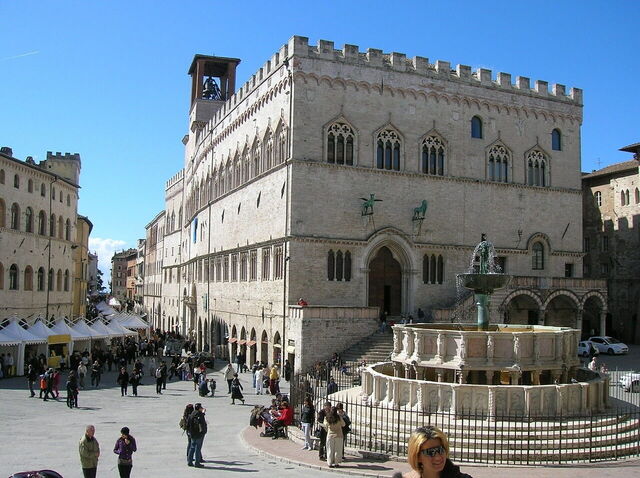
The Palazzo dei Priori in Perugia is one of the finest and most striking buildings in the city.
It is also home to the National Galley of Umbria and is, therefore, one of the must-see attractions if you have found a holiday rental in Perugia and are spending time in this charming city.
Between trying the excellent local chocolate, visiting the stunning churches and wandering the Old Town, be sure to stop by this architectural gem stuffed to the gills with the most important local artistic treasures of times gone by.
Built between the 13th and the 15th centuries, the Palazzo dei Priori is a distinctively austere building. A large rectangular block of pale stone, it has minimal decorative elements with large expanses of unembellished masonry.
It is also home to the National Galley of Umbria and is, therefore, one of the must-see attractions if you have found a holiday rental in Perugia and are spending time in this charming city.
Between trying the excellent local chocolate, visiting the stunning churches and wandering the Old Town, be sure to stop by this architectural gem stuffed to the gills with the most important local artistic treasures of times gone by.
Built between the 13th and the 15th centuries, the Palazzo dei Priori is a distinctively austere building. A large rectangular block of pale stone, it has minimal decorative elements with large expanses of unembellished masonry.
This severely restrained canvas is punctuated by rows of elegant pointed Gothic windows which make up the majority of the sparingly employed decoration. The first public palace of Perugia was the Palazzo del Podestà but when the new magistracy of the Capitano del Popolo was introduced the possibility of building a new palace for this magistracy was discussed.
Other civic projects were being undertaken at the time so this new palace was delayed but the nucleus of the building was begun by the end of the thirteenth century.
Other civic projects were being undertaken at the time so this new palace was delayed but the nucleus of the building was begun by the end of the thirteenth century.
In the 14th century, there were extensions added including the Sala del Consiglio and, behind it, the Sala dell’ Udienza (Audience Chamber) and the priors' refectory where a fresco of the Last Supper by the young Giannicola di Paolo was recently uncovered. The growth in the bureaucracy of Perugia in the early 15th century also necessitated further expansion which was executed in an anachronistic style that preserved the harmony of the integrated structure of the palazzo. Further extensions and alterations were undertaken over the centuries and in the period 1862-1936, there was a long and difficult project of restoration. The asymmetrical and irregular facade of the building is the result of these various stages in which it was built.
The Galleria Nazionale dell'Umbria, is housed in twenty-three rooms on the third floor of the palazzo and is comprised of the greatest collection of works from the Umbrian School of painting between the 13th and the 19th centuries. The origins of the collection lie in the founding of the Perugian Accademia del Disegno in the mid-16th century. In 1863, the civic paintings collection was formally named to commemorate Pietro Vannucci but they didn't find a permanent home until they were placed in the palazzo in 1873.
The gallery became the Regia Galleria Vannucci (Royal Vannucci Gallery) in 1918, under the patronage of the king, and houses works by the likes of works by Duccio, Piero della Francesca, Beato Angelico, Perugino.
Today, the ticket to visit the palazzo will also allow you to gain access to the gallery making it a bargain as well as one of the most important sights to see in this wonderful Italian city.
The Galleria Nazionale dell'Umbria, is housed in twenty-three rooms on the third floor of the palazzo and is comprised of the greatest collection of works from the Umbrian School of painting between the 13th and the 19th centuries. The origins of the collection lie in the founding of the Perugian Accademia del Disegno in the mid-16th century. In 1863, the civic paintings collection was formally named to commemorate Pietro Vannucci but they didn't find a permanent home until they were placed in the palazzo in 1873.
The gallery became the Regia Galleria Vannucci (Royal Vannucci Gallery) in 1918, under the patronage of the king, and houses works by the likes of works by Duccio, Piero della Francesca, Beato Angelico, Perugino.
Today, the ticket to visit the palazzo will also allow you to gain access to the gallery making it a bargain as well as one of the most important sights to see in this wonderful Italian city.