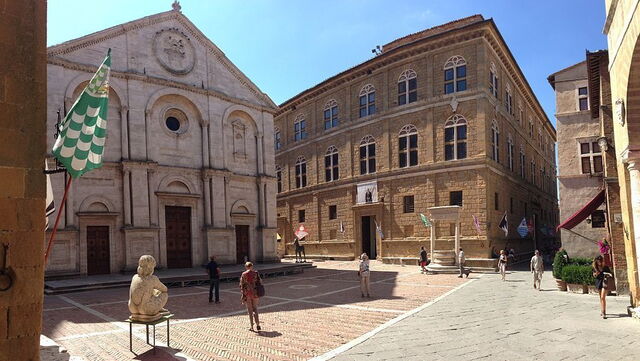
Pienza is a small village in the Val d'Orcia in southern Tuscany. Set high atop a hill, overlooking the Orcia Valley, it has extraordinary views. The village is often known as the "ideal Renaissance city” and is the creation of the great humanist Enea Silvio Piccolomini, who later became Pope Pius II. Piccolomini used his money and influence to transform his birthplace of Corsignano, into his idea of a Utopian city. This is what eventually would come to be known as Pienza. Based on classical ideas of geometry and elegance, it is comprised of beautiful buildings and harmonious street plans.
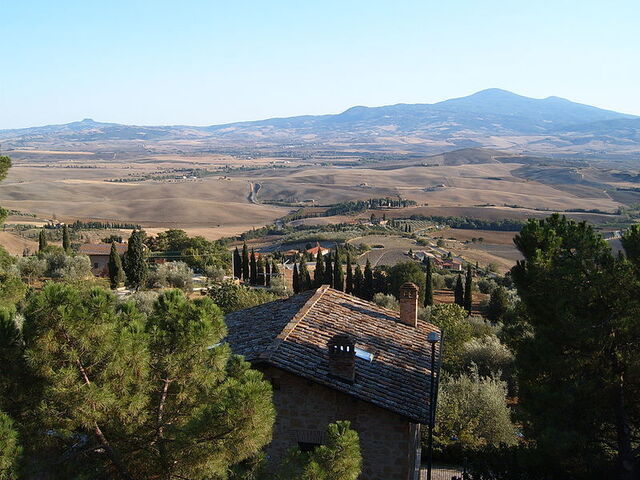
If you want to wander the streets of an ideal town for yourself find a luxury villa in Pienza!
The town was designed by architect Bernardo "il Rossellino" along with the guidance of the great humanist, architect and author, Leon Battista Alberti. Pope Pius II, travelled widely around Europe in preparation for the work on the town and looked for inspiration in the Gothic cathedrals of northern Europe. Twenty thousands builders worked on the project and it was completed in just three years. Pius II also made sure that no one would ever alter his ideal creation with excommunication being the punishment for any who tried it. As a result, the 15th century emphasis on public spaces to allow for socialising and happiness is retained.
The town was designed by architect Bernardo "il Rossellino" along with the guidance of the great humanist, architect and author, Leon Battista Alberti. Pope Pius II, travelled widely around Europe in preparation for the work on the town and looked for inspiration in the Gothic cathedrals of northern Europe. Twenty thousands builders worked on the project and it was completed in just three years. Pius II also made sure that no one would ever alter his ideal creation with excommunication being the punishment for any who tried it. As a result, the 15th century emphasis on public spaces to allow for socialising and happiness is retained.
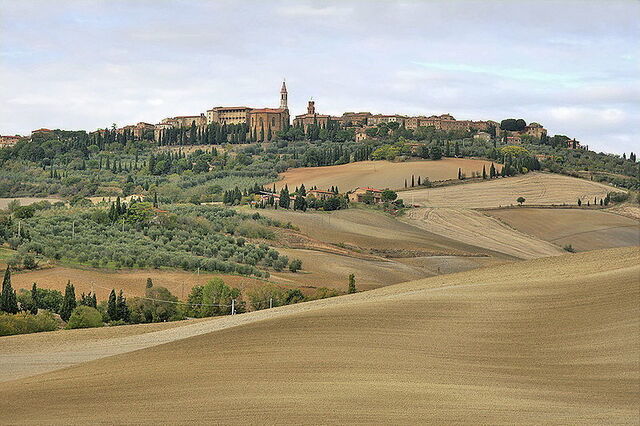
After just three years, a Cathedral, the Papal Palace, the Town Hall and central piazza were completed. This piazza, the Piazza Pio II, is of a perfect harmonious shape, tying together the group of buildings. The Duomo is home to works of art by named Sienese artists of the period and is a rare combination of Gothic and Renaissance forms. Built on the site of the Romanesque Abbey Church of Santa Maria, it was conceived as a way to make a perfect scenographic effect in the city’s main piazza with a towering octagonal campanile that points to the sky and dominates the landscape. The interior is on a plan with three naves and an apse which is divided into three chapels.
The Papal Palace, or Palazzo Piccolomini, to the right of the Duomo has a large loggia with hanging garden from which there are breathtaking views across the Val d'Orcia Valley. Inspired by Leon Battista Alberti’s Palazzo Rucellai in Florence, it is on a square plan and over three floors. The façade is emblazoned with the family crest in stone and apostolic emblems in gold and silver while the interior houses a small, rectangular courtyard, with loggia and garden at the centre. The palace was actually used for filming scenes of Franco Zeffirelli's Romeo and Juliet.
Recognised as a UNESCO World Heritage Site since 1996, preserved of its 15th century splendour and attracting tourists and film crews alike, Pienza is a truly unique and wonderful city, if you find yourself in the Orcia Valley, you must find time to wander its perfect streets.
The Papal Palace, or Palazzo Piccolomini, to the right of the Duomo has a large loggia with hanging garden from which there are breathtaking views across the Val d'Orcia Valley. Inspired by Leon Battista Alberti’s Palazzo Rucellai in Florence, it is on a square plan and over three floors. The façade is emblazoned with the family crest in stone and apostolic emblems in gold and silver while the interior houses a small, rectangular courtyard, with loggia and garden at the centre. The palace was actually used for filming scenes of Franco Zeffirelli's Romeo and Juliet.
Recognised as a UNESCO World Heritage Site since 1996, preserved of its 15th century splendour and attracting tourists and film crews alike, Pienza is a truly unique and wonderful city, if you find yourself in the Orcia Valley, you must find time to wander its perfect streets.
Photo credits
picture 1: Oschirmer / CC BY-SA 3.0;
picture 2: Markus Bernet / CC BY-SA 2.5;
picture 3: Sherseydc / CC BY-SA 2.0
picture 1: Oschirmer / CC BY-SA 3.0;
picture 2: Markus Bernet / CC BY-SA 2.5;
picture 3: Sherseydc / CC BY-SA 2.0