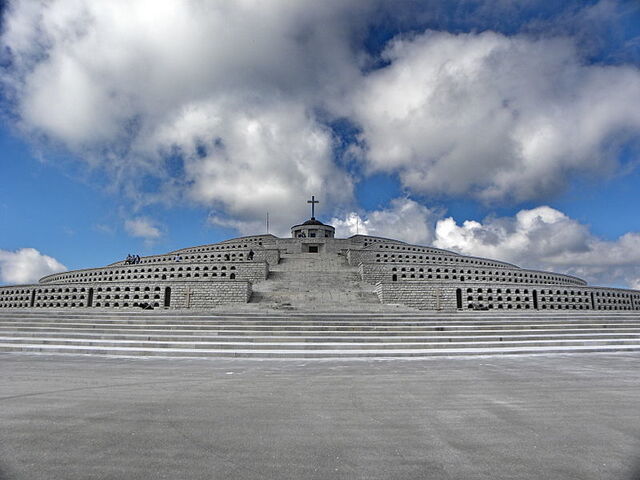
A very special monument is perched on the top of Mount Grappa in Treviso. This is the Military Memorial Monument of Mount Grappa, or the Sacrario Militare Del Monte Grappa, which is one of the most important military ossuaries of WWI. It was built in 1935, and was designed in collaboration by Giovanni Greppi and Giannino Castiglioni. Its distinctive architecture is inspired by military fortification and the striking form rises up against the skyline, large and austere. The result is rather dramatic. If you're a WWI buff or fond of dramatic 20th century architecture and landscapes, this is the perfect spot for you. Find a luxury villa in Veneto and spend a day trekking the mountain with the view of the area and the monument as your reward.
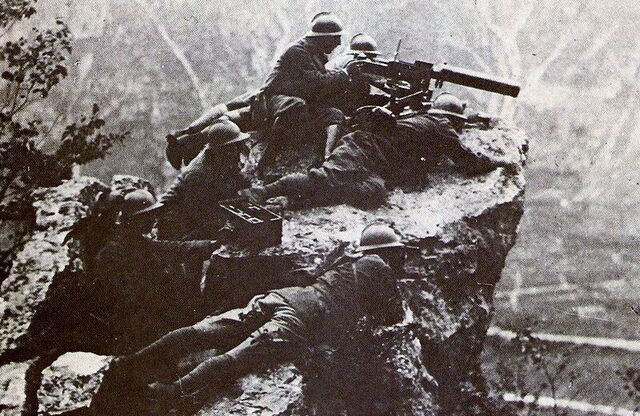
Several battles took place in Veneto during WWI. Monte Grappa became one of the central points of the Italian lines of defence. The Austrians tried several times to conquer it and invade the Venetian plain but were finally defeated in the battle of Vittorio Veneto in October 1918. It was decided to build a monument at the top of the Monte Grappa, after the war, to gather the remains of soldiers of both sides. During WWII, antifascist groups were formed and located on Monte Grappa, from which they controlled, a communication route for Germany with the Nazi forces operating in Italy. The response to this was a 'clean up' operation, killing 1,500. A monument to them has also been established at this site.
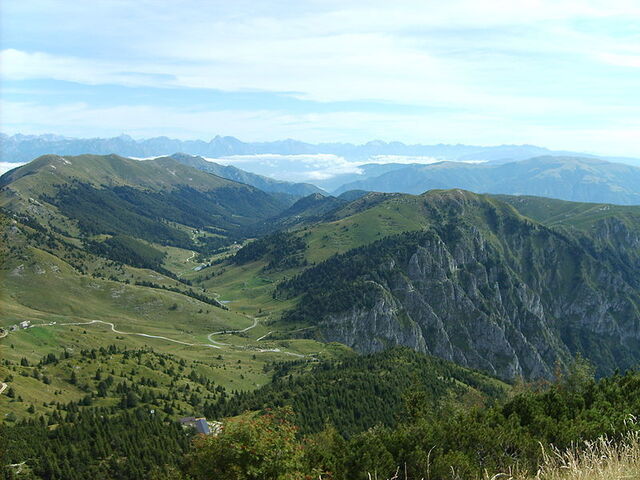
The main monument is composed of five concentric circles, laid on top of each other to form a pyramid and each circle being four meters high and enclosed by a circular terrace 10 meters high, with a little sanctuary on top called the Sanctuary of the Madonnina del Grappa. Made of white local stone, the structure curves with the mountain so that it almost seems to spring naturally from the earth. The central part of the monument, made up of the concentric circles, houses the bodies of 12,615 soldiers (of which 10,332 are unnamed). The remains of the identified soldiers are arranged alphabetically and stored in niches covered by bronze plates, with their names and decorations for military valour engraved upon them.
The remains of the 10,332 unknown soldiers are held in larger, communal urns, alternating between the single tombs. A large, sweeping staircase to the centre connects the five circles, with five flights leading from the base of the monument all the way to the top and the shrine located there. At the top of the monument a pathway makes its way to the Portale Roma between two rows of stone blocks, each carved with the names of the locations where the most noted battles held on Grappa took place. Whether or not you're interested in history, this striking monument and its setting are a must-see in Veneto.
The remains of the 10,332 unknown soldiers are held in larger, communal urns, alternating between the single tombs. A large, sweeping staircase to the centre connects the five circles, with five flights leading from the base of the monument all the way to the top and the shrine located there. At the top of the monument a pathway makes its way to the Portale Roma between two rows of stone blocks, each carved with the names of the locations where the most noted battles held on Grappa took place. Whether or not you're interested in history, this striking monument and its setting are a must-see in Veneto.
Photo credits
picture 1: Gabriele Dalla Porta / CC BY-SA 2.0;
picture 3: Rics1299 / CC BY-SA 3.0
picture 1: Gabriele Dalla Porta / CC BY-SA 2.0;
picture 3: Rics1299 / CC BY-SA 3.0