The Archiginnasio (the Greek for “first school”) of Bologna is the ancient seat of the University of Bologna and one of the most singularly unique buildings in the city. Originally it was the main building of the “Studium”, as the university was once called. That is, until 1803, when it became the site of the Institute of Science. In 1838, part of the building was made into the Archiginnasio Municipal Library. It continues to function as a working library to this day and is the biggest in Emilia-Romagna. It houses historical, philosophical, political, literary, artistic, biographical and bibliographical works in addition to a large section devoted to the culture of Bologna. It also contains over 35,000 manuscripts and pamphlets.
The building truly has to be seen in order for one to understand its impact, beauty and majesty. Why not find a villa with swimming pool in Emilia-Romagna and spend a day in Bologna's historic centre?
When Piazza Maggiore was being remodelled under papal orders, the construction of the Archiginnasio was commissioned by Pope Pius IV through the papal legates, Charles Borromeo and Pier Donato Cesi. The project was then overseen by Antonio Morandi who finished the construction between 1562 and 1563. The idea was to house the various faculties of the University, which were dispersed throughout the city until then, in one place.
When Piazza Maggiore was being remodelled under papal orders, the construction of the Archiginnasio was commissioned by Pope Pius IV through the papal legates, Charles Borromeo and Pier Donato Cesi. The project was then overseen by Antonio Morandi who finished the construction between 1562 and 1563. The idea was to house the various faculties of the University, which were dispersed throughout the city until then, in one place.
The university, the world’s oldest in continuous operation, was founded in 1088 and it was felt that it was time to give it a proper base of operations in the city.
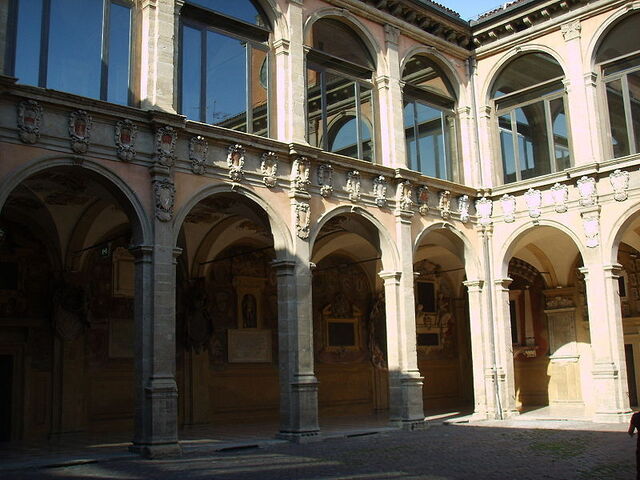
The building is comprised of two storeys with a courtyard at the centre. Upstairs were the rooms for the students studying law and below were the students of other subjects such as arts and medicine. Two grand staircases lead up to this space but the rooms are, sadly, currently closed off to visitors. The walls of the building are decorated in a huge heraldic scheme composed of 7000 coats of arms. These show the homeland or city and name of the students represented.
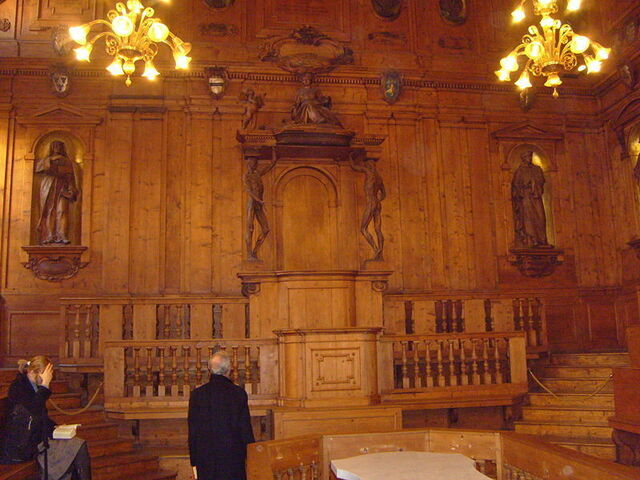
The Anatomical Theatre, built in 1637, is considered one of the highlights of the building. Panelled in spruce and with a coffered ceiling, it is arranged amphitheatre-style with a large pulpit-like space at the head of the room from which the lecturer would teach the class. Niches in the walls of the house wooden statues by Silvestro Giannotti of historic physicians. The statues on each side of the professor’s chair by well-known wax model artists, Ercole Lelli, are carved to look as though their skin has been removed and to make their muscles visible. At the centre of the room stands a white marble table used for dissections.
This building is truly stunning and a fascinating place to visit. If you find yourself in Bologna, do stop by.
The building is comprised of two storeys with a courtyard at the centre. Upstairs were the rooms for the students studying law and below were the students of other subjects such as arts and medicine. Two grand staircases lead up to this space but the rooms are, sadly, currently closed off to visitors. The walls of the building are decorated in a huge heraldic scheme composed of 7000 coats of arms. These show the homeland or city and name of the students represented.
The Anatomical Theatre, built in 1637, is considered one of the highlights of the building. Panelled in spruce and with a coffered ceiling, it is arranged amphitheatre-style with a large pulpit-like space at the head of the room from which the lecturer would teach the class. Niches in the walls of the house wooden statues by Silvestro Giannotti of historic physicians. The statues on each side of the professor’s chair by well-known wax model artists, Ercole Lelli, are carved to look as though their skin has been removed and to make their muscles visible. At the centre of the room stands a white marble table used for dissections.
This building is truly stunning and a fascinating place to visit. If you find yourself in Bologna, do stop by.