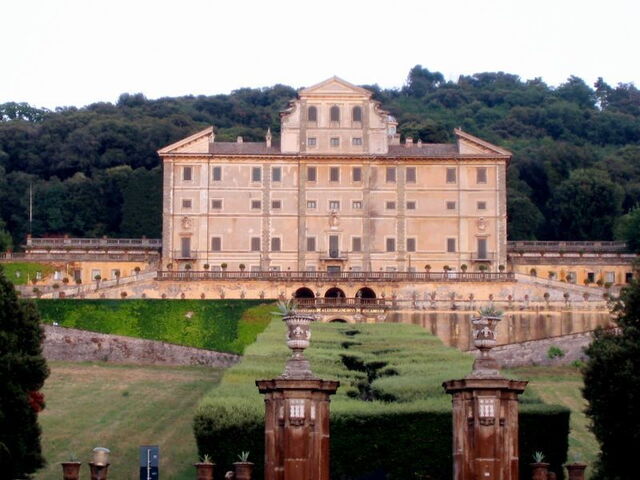
The Villa Aldobrandini is a villa in Frascati, a town in the province of Rome. The original villa on the site was built by Alessandro Rufini in 1550. In 1598, it was given by Pope Clement VIII to his nephew, Cardinal Pietro Aldobrandini, from whom the villa takes its name. It is the only papal villa which is not owned by the state and is, instead, still owned and occupied by members of the Aldobrandini family, though its gardens are (luckily) open to the public on a daily basis.
Find a villa with pool in the Latium region and you could spend a day wandering these historic and famous gardens which are considered the best of early Italian Baroque style.
Find a villa with pool in the Latium region and you could spend a day wandering these historic and famous gardens which are considered the best of early Italian Baroque style.
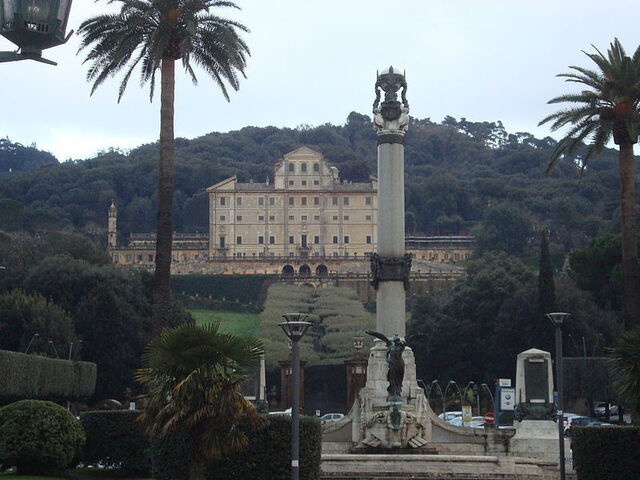
The palace is the centrepiece of the garden layout, set into a wooded hill with a view across the countryside to the dome of St Peters, Rome.
Giacomo della Porta was commissioned to design the new villa on the site and all surrounding structures that might have imposed on the view were cleared away.
The surrounding vistas across the Roman landscape from the villa are particularly amazing and gave rise to its nickname of Villa Belvedere (Good View). With its large and imposing façade and position on top of a series of terraces, it is clearly visible from Rome and has become an important landmark in the area.
Giacomo della Porta was commissioned to design the new villa on the site and all surrounding structures that might have imposed on the view were cleared away.
The surrounding vistas across the Roman landscape from the villa are particularly amazing and gave rise to its nickname of Villa Belvedere (Good View). With its large and imposing façade and position on top of a series of terraces, it is clearly visible from Rome and has become an important landmark in the area.
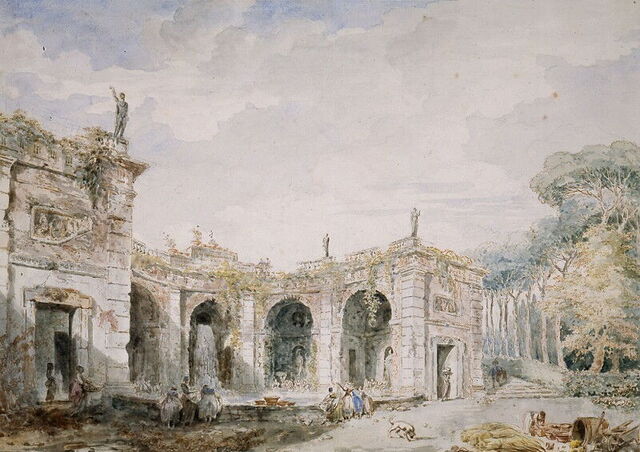
While the building is a magnificent example of Baroque architecture, it is the garden which is a huge focus. Much of the attention is drawn outside, through the windows, to take in the garden and surroundings. In fact, the building is not nearly so large as it appears, lacking wings surrounding an inner court so that every room can look towards Rome or the gardens.
Work on the garden began in 1598 and it was finished by 1603. With the death of della Porta in 1602, the project for the design of the casino, gardens and fountains was completed by the architects Carlo Maderno and Giovanni Fontana.
The grand avenue which leads up to the villa is flanked either side by trees which arch to form a tunnel. Gardens of formally planted plane trees and hydrangeas surround and a wood of oak and chestnut trees is to the rear. The gardens also feature a nymphaeum, for which it is famous, with niches for statues and fountains and a statue of Atlas at the centre. Behind this an aquaduct moves into the woods, bringing water 8km from a spring on the mount Algido to provide water for the feature. The elaborate waterworks were designed by Maderno with Orazio Olivieri.
The top of the garden has remained somewhat derelict since being damaged by bombing during WWII. Some statues are missing today and the fountains no longer work but the gardens are still beautiful and the views remain stunning. If you are spending time in the Latium region be sure to wander the grounds and gaze down at the impeccable view of Rome.
Work on the garden began in 1598 and it was finished by 1603. With the death of della Porta in 1602, the project for the design of the casino, gardens and fountains was completed by the architects Carlo Maderno and Giovanni Fontana.
The grand avenue which leads up to the villa is flanked either side by trees which arch to form a tunnel. Gardens of formally planted plane trees and hydrangeas surround and a wood of oak and chestnut trees is to the rear. The gardens also feature a nymphaeum, for which it is famous, with niches for statues and fountains and a statue of Atlas at the centre. Behind this an aquaduct moves into the woods, bringing water 8km from a spring on the mount Algido to provide water for the feature. The elaborate waterworks were designed by Maderno with Orazio Olivieri.
The top of the garden has remained somewhat derelict since being damaged by bombing during WWII. Some statues are missing today and the fountains no longer work but the gardens are still beautiful and the views remain stunning. If you are spending time in the Latium region be sure to wander the grounds and gaze down at the impeccable view of Rome.
Photo credits
picture 1: iessi / CC BY 2.0;
picture 2: LPLT / CC BY-SA 3.0
picture 1: iessi / CC BY 2.0;
picture 2: LPLT / CC BY-SA 3.0