Exterior of Sorrento Cathedral
Posted in: Campania Churches & Religious Buildings Southern Italy Tourist Attractions
Sorrento Cathedral was built in the 11th century and then rebuilt in the early fifteenth century in the Romanesque style. Since then there have been multiple bouts of rebuilding and restoration up to 1924 when the entire façade was rebuilt. It is located in the centre of this beautiful seaside town, near the main street, Corso Italia. Open daily and free to visit (though donations for the upkeep of the church are welcomed and encouraged) it is an exceptionally lovely Italian cathedral which offers a moment of quiet reflection during your trip as well as representing several different periods in the history of Italy's art and architecture. Find a villa with pool in Sorrento and wile away days wandering the coastline, exploring the city and seeing the sights!
Chapel at Urbino Cathedral
Posted in: Central Italy Churches & Religious Buildings The Marches Tourist Attractions Unesco World Heritage Sites
If you are visiting Urbino and have already stopped by the Palazzo Ducale to see the National Museum and palace itself, then you might think about taking a few moments to stop at the Duomo, or cathedral, just next door. Both buildings are part of Urbino's UNESCO heritage and were at the centre of the urban renewal of the beautiful city by the ducal family in the Renaissance, though the cathedral was altered in the 18th century and now bears a neoclassical edifice instead. The Duomo is the perfect complement to a visit to the palace as many of the same artists and designers who worked in the palace also lent their skills to the redesign of the church.
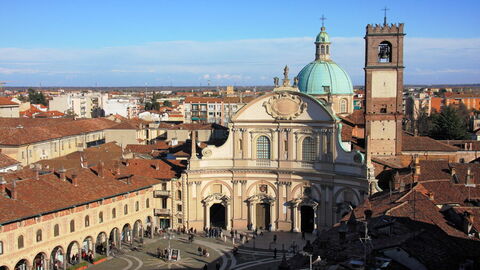
Cathedral of St Ambrose, Vigevano
Posted in: Churches & Religious Buildings Curiosities Lombardy Northwest Italy Tourist Attractions
The Cathedral of St. Ambrose is a building in Lombardy with roots going as far back as the tenth century, though the present structure dates to the sixteenth.

It is the seat of the Bishop of Vigevano and the current building was commissioned by Duke Francesco II Sforza in 1530.

Dedicated to St. Ambrose, it was designed by Antonio da Lonate and thought it was begun shortly afterwards, work was not completed until 1612.

With beautiful painted interiors, a newer Baroque façade and a famous treasury and museum inside, it is a typical Italian cathedral in many ways.
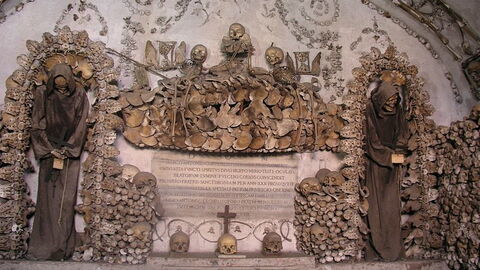
Altar in the Crypt of Santa Maria della Concezione
Posted in: Central Italy Churches & Religious Buildings Curiosities Latium Tourist Attractions
Located on the upscale Via Veneto in Rome, Santa Maria della Concezione is dedicated to Our Lady of the Immaculate Conception. It was built in 1626 by Cardinal Antonio Barberini, the younger brother of Pope Urban VIII, who was a Capuchin friar. Antonio Casoni and another Capuchin Friar, Michele da Bergamo, were the architects and they built a beautiful but simple church. The real interest in this site, however, is what lies below. When the Capuchins moved from their location at the Quirinal to the Via Veneto site, they brought the bones of around 4000 friars and placed them in a cemetery under the church, arranged in patterns on the walls and ceilings. The result is eerie and very unusual. Find a holiday rental in Rome and see it yourself.
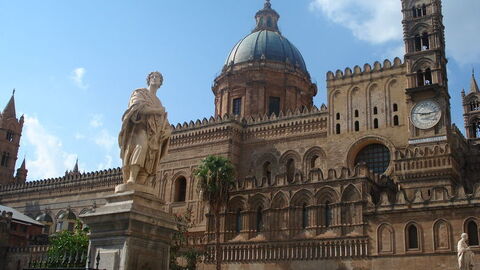
Exterior, by the apse
Posted in: Churches & Religious Buildings Main Islands Sicily and Sardinia Tourist Attractions
Palermo Cathedral was founded on the site of a Muslim mosque, which in turn had replaced an Early Christian basilica in 1184 by the Archbishop of Palermo. His aim was to create something more astounding than the cathedral at Monreale nearby and so a competition broke out between the two cathedrals which became known as the “Battle of the Two Cathedrals”. It is still debatable as to who the winner was but the cathedral at Palermo is stunning in its own right. A fantastic example of the Arab-Norman architecture that is awaiting news on UNESCO status and which is one of the defining characteristics of the city, it is a must-see for any with a love of Western churches, Islamic architecture and Byzantine mosaics as it sees all three combined.