Courtyard, Villa Cimbrone
Posted in: Amalfi Coast Architectural Gems Campania Localities Must See Attractions Parks & Gardens Southern Italy Tourist Attractions
The Villa Cimbrone is a historic villa located on a rocky outcrop known as "Cimbronium", from which it takes its name, in Ravello that dates to at least the 11th century AD. The earliest references to the villa from this time refer to when the villa belonged to the Accongiogioco, a noble family. It later became the property of the wealthy and influential Fusco family, who are also recorded as owning the local church of S. Angelo de Cimbrone in the 13th century. Later still, it became part of the nearby monastery of Santa Chiara. Ownership from the seventeenth century is uncertain, but by the second half of the nineteenth century it had come into the possession of the Amici family of Atrani.

In the 20th century, the villa was altered and extended by Ernest William Beckett, who brought in salvaged architectural elements from other parts of Italy and elsewhere, leaving little of the original structure visible.
Posted in: Architectural Gems Liguria Must See Attractions Northwest Italy Parks & Gardens Tourist Attractions
Genoa is a great unsung hero that many often don't hear much about. It does not seem to garner the endless lines and lines of press that are published about other Italian cities every day but it should. It is a wonderful beauty, filled with architectural gems and hidden treasures. Its history is rich and its cultural heritage is fascinating. Even its graveyard is a stunner.

Among all the sights and attractions, however, one stands apart. It is hard not to notice the Biosfera by famous architect Renzo Piano. Just find a villa in Liguria and pay a visit to this extraordinary structure for yourself.

Renzo Piano was the 1998 Pritzker Prize winner and is probably best known for his controversial design of the Centre Georges Pompidou but is a prolific architect that his left his stamp all over the world. Piano was actually born in Genoa in 1937 and comes from a family of builders.
Bosco Verticale, Milan
Posted in: Architectural Gems History Localities Milan Northeast Italy Tourist Attractions Veneto
In our final installment in this series, we bring you two more of the most interesting, unique and bizarre architectural feats in Italy, a land well-known for its artistic prestige and innovations. While these buildings may be no less beautiful or important than others throughout the country, they may be less recognisable. If you're an architecture lover or if you merely like checking out strange attractions on your holidays, be sure to read the whole list!

If you're interested at all in contemporary architecture or design or you're just fond of seeing the most unique and unusual things that a city has to offer while on holidays, then Milan has the perfect thing for you. The Bosco Verticale, or Vertical Forest, is a highly unique building in Milan which was opened in 2014. It is composed of a pair of high-rise buildings which are made up of 27 storeys with cantilevered balconies planted with 900 trees and more than 2,000 shrubs and bushes.
Appennine Colossus
Posted in: Architectural Gems Central Italy Florence History Latium Localities Renaissance Tourist Attractions
While there is no shortage of stunning buildings and architectural gems all across Italy, there are some rather special buildings among their number. These buildings and architectural ventures may be great works of art but they have aspects to their design, usage, ornamentation or origin stories that are fascinating, unique and rather bizarre. Continuing from our last post, here are some more of the strangest architectural feats in Italy.

The Renaissance gave birth to an endless list of extraordinary architectural gems and outstanding garden designs, such as the Villa Demidoff. Located about seven miles north of Florence, the gardens are home to many different sculptures, fountains and various other delights. The highlight, however, has to be the Appennine Colossus. Measuring about 35 feet tall, the Colossus is a personification of the Apennine mountain ranges, and is depicted as a blend between mountain and man, its smooth skin emerging out of the surrounding mountainous setting.
Galleria Borbonica
Posted in: Architectural Gems Campania Museums & Galleries Southern Italy Tourist Attractions
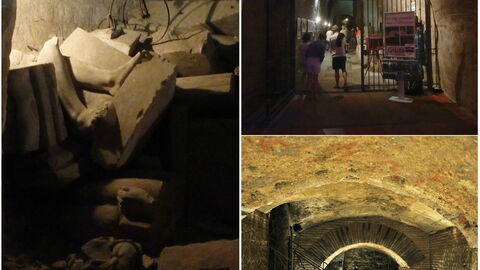
The Galleria Borbonica, or Bourbon Tunnel, is an ancient military underground passage that connects the Royal Palace to the military barracks in Naples. It was built to allow the king to flee to the sea and the soldiers to defend the palace quickly and remains a rather intriguing reminder of the past. Errico Alvino was commissioned by Ferdinand II in 1853 to construct this military passage due to his paranoia about the outbreak of a rebellion. His paranoia turned out to be well-founded as, two years after construction began, the fall of the Bourbon dynasty led to halt of all work on the tunnel.

A network of tunnels carved into the aqueducts of the city, it is 530m in length and remained unused and abandoned until WWII. During the hundreds of bombings in World War II, the people of Naples used the underground passages as shelters. There were also military hospitals established in the tunnel. Furthermore, confiscated vehicles such as cars and bicycles that were taken in this period were kept in the tunnels. A fascist monument made for Aurelio Padovani was also abandoned underground.

Then, again, the tunnels were forgotten until the 2000s, when the curious artefacts that were housed inside and the fascinating passages themselves began to garner attention from locals. In 2014, the tunnels were opened to the public and are now a tourist attraction. You can take several different tours of the tunnels including the Standard Tour, the Adventure Tour (80 minutes; adult/reduced €15/10) and adults-only Speleo Tour (2½ hours; €30).

Standard Tours take you around the displays of vintage cars, motorbikes and water tanks. The Adventure Tour, sees visitors enter a cistern still full of water and sail under the city on a raft. More extreme adventurers, meanwhile, might be more interested in the Speleo Tour, which sees participants don a hard hat and overalls and go crawling through aqueduct tunnels to reach the most beautiful water cisterns.

If you are exploring the city of Naples or have found a luxury villa in Campania, a visit to the Galleria Borbonica is a perfect alternative to more typical tourist attractions and promises to offer a rather unique experience!