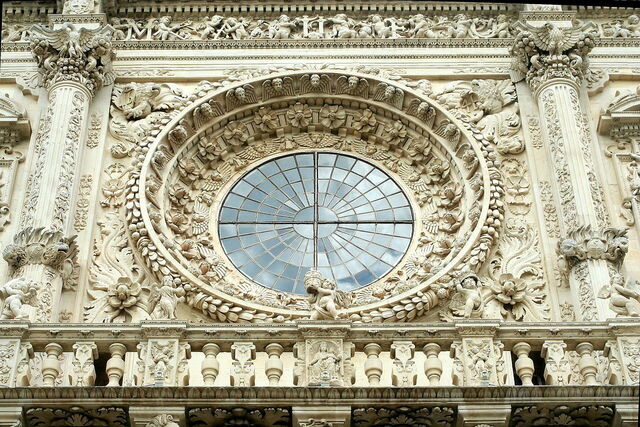
Lecce is a city famous for its stunningly ornate Baroque architecture in its charming historic centre. Among the beautiful buildings that account for this distinct Baroque heritage, the Basilica of Santa Croce stands out as one of the most strikingly lovely examples. A master class in sculpture with an elaborately appointed exterior and a grand interior, it is a place where you could easily spend hours walking around and taking in all of the detail. Certainly, for those who book a villa in Apulia and who are exploring Lecce, it is a must-see attraction that will reward visitors with truly breath-taking beauty and a fascinating history.
The origins of the Basilica of Santa Croce go back to the 14th century, when Walter VI, Count of Brienne, founded a monastery on the site. In 1549, construction of the church began, making use of neighbouring sites that had been acquired, including from the homes of Jewish inhabitants who had been ousted from the city 39 years previously. The building was not finished, however, until 1695, almost 150 years later, with various parts completed piecemeal.
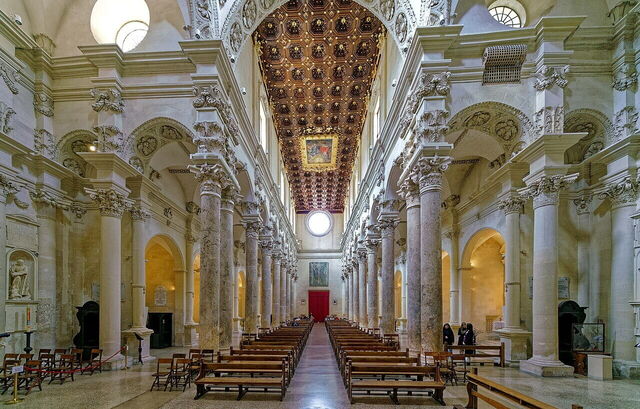
Built on a Latin cross plan, the church originally had a nave with four aisles but an aisle on each side was turned into side chapels in the 18th century. There are seventeen altars in total with the main altar being adorned by the herald of the Adorni family, who were interred in tombs inside the basilica. A central dome rises above the church, flooding the interior with light and raising the spirits of those who enter.
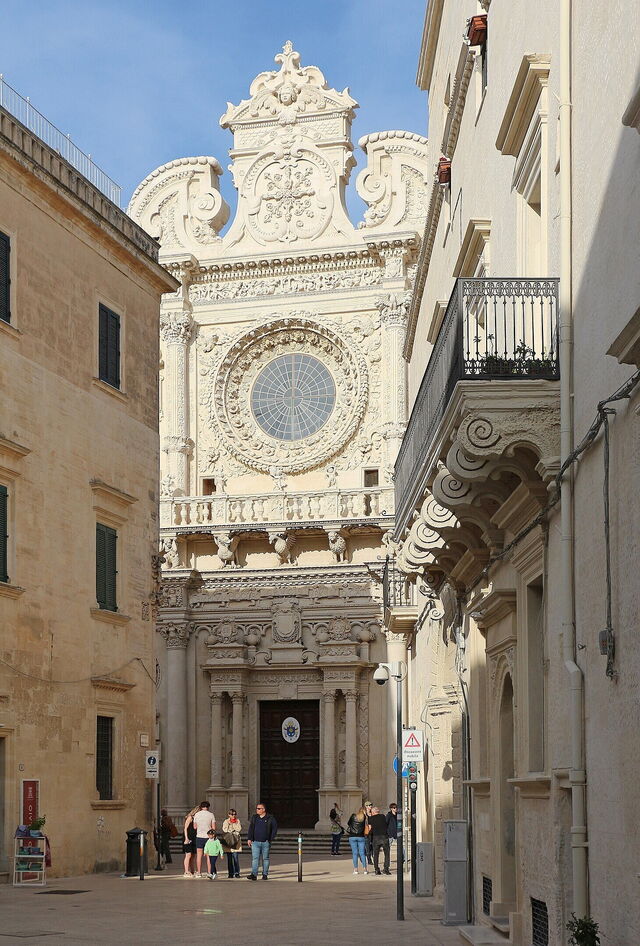
Upon approach, it is, of course, the façade that visitors first get to admire. Peeks of the building are visible along the pretty and historic surrounding streets and then, when you arrive at the small piazza in front of the building, you can pause and take it all in before diving into the truly incredible level of detail. It is divided into five bays by the six Corinthian columns and has a main portal at its centre that is also framed by an additional pair of smaller Corinthian columns on either side.
The insignias of Philip III of Spain, Maria d'Enghien, and Walter VI of Brienne are all displayed over this portal and a Greek key pattern frames the door itself. Cherubs, or putti, on the portal carry crowns and tiaras symbolising temporal and spiritual power and others, around the rose window and above it, frolic and fight. Sculptures of grotesque figures along with fantastical and allegorical animals support the balustrade. In addition to all of this is a variety of gorgeous floral and vegetation designs, figures of saints, other animals, scrolls and geometric designs, and more are carved into this sumptuous façade, which truly is a feast for the eyes and an unmissable experience if you are in the city during a holiday in Apulia.
Once you have managed to prise your gaze away from all there is to see outside, you can then step into the basilica where this fantastical level of detail and beauty continues from the gorgeous coffered ceiling in walnut with gilding of the main nave, the two orders of marble columns (18 in total) with their rich sculptural detail, and the sculptural decorations on the base of the dome and under arches. The current high altar dates back to the 18th century and was actually transferred to the Basilica of Santa Croce from the Church of Saints Niccolò and Cataldo in 1956, when the XV National Eucharistic Congress was held in Lecce.
On the apse walls there is a series of paintings of the Adoration of the Shepherds, the Annunciation, the Visit of Mary to Saint Elizabeth, and the Rest on the Flight into Egypt. There are seven chapels on each side of the church, each with a different, elaborately decorated altar dedicated to various saints and biblical scenes including the Annunciation and the Immaculate Conception. Among these, the altar dedicated to Saint Francis of Paola by the renowned Baroque architect Francesco Antonio Zimbalo is considered a masterpiece of the style and period.
While some of the specifics of the biblical references, allusions to certain saints and local historical figures, and more might not be necessarily familiar to all guests, particularly those who do not have a Christian background, anyone can appreciate the impossibly sumptuous detail and artistic mastery that is on clear display all throughout the church. Certainly, the more time you take to admire this remarkable building, the more you will see – from funny little details to impressive examples of virtuosity.
So, if you book a vacation rental in Apulia and you are coming to Lecce for the day to dive into her astounding Baroque architectural heritage, be sure to plan a visit to the Basilica of Santa Croce to see, perhaps, the best example of the style in the city.