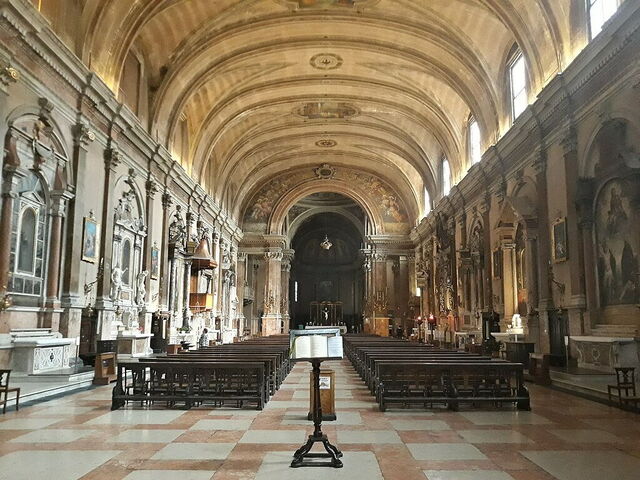
Verona is already known internationally as a great city of romance in Italy as it was home to, perhaps, the most famous lovers of all time, Romeo and Juliet. In addition to this incredible claim to fame, the architecture of this charming town in Veneto is impossibly pretty and picturesque, adding to the thoroughly romantic ambiance of the place. Of all the lovely and romantic buildings in town, one of the best examples is the exceptionally charming Church of Sant'Eufemia, or Chiesa di Sant'Eufemia. If you have found a vacation rental in Verona and are spending time exploring the city then we highly recommend popping in for a visit to this wonderful architectural gem.
The Church of Sant'Eufemia is located right in the heart of the historic centre of Verona, over the site of a church that dates back to the 5th or 6th century. Various other buildings were placed over top throughout the centuries, with the foundation of the current church dating to the 13th century, when the ruling Della Scala family brought Augustinian monks to the city to build a monastery in what was then the Captains quarter of the city. Though they were brought to Verona in 1262, the necessary donations and funds had to first be gathered in order to pay for the construction of the new church and monastery. The bequest of Alberto della Scala, in particular, was integral in the funding and completion of the project.
The Church of Sant'Eufemia is located right in the heart of the historic centre of Verona, over the site of a church that dates back to the 5th or 6th century. Various other buildings were placed over top throughout the centuries, with the foundation of the current church dating to the 13th century, when the ruling Della Scala family brought Augustinian monks to the city to build a monastery in what was then the Captains quarter of the city. Though they were brought to Verona in 1262, the necessary donations and funds had to first be gathered in order to pay for the construction of the new church and monastery. The bequest of Alberto della Scala, in particular, was integral in the funding and completion of the project.
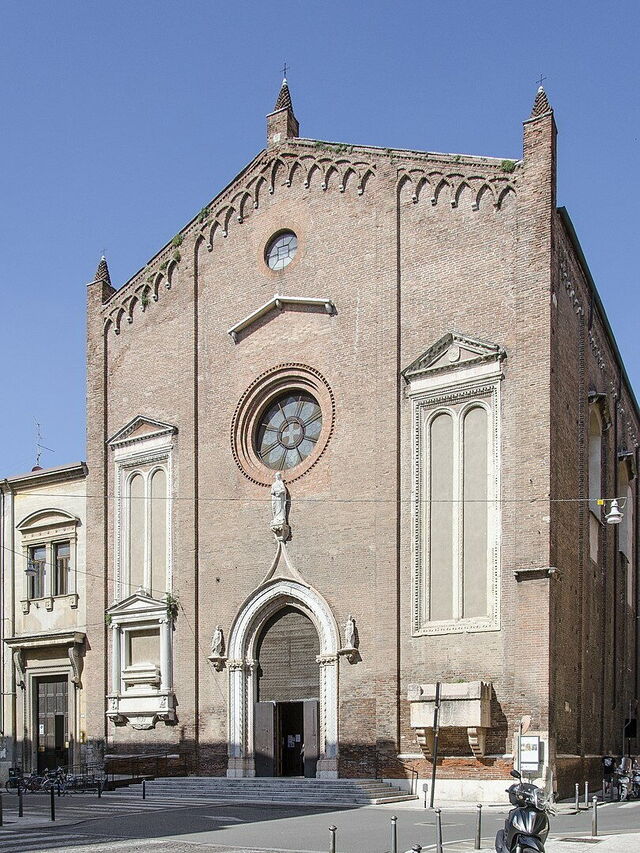
In 1331, the building was consecrated by the bishop of Verona, though this did not mean the end of the building and the monastery was expanded over the following centuries to allow for the increasing number of monks who arrived, attracted by the great reputation of the monastery, and to see the enlargement and beautification of the church. In 1340, Mastino II della Scala gave permission for additions to the church, which included creating the vast apse for which it is still known and, throughout the rest of the century, various chapels and minor altars were added. Throughout the 16th century the Gothic church was redecorated to better reflect and suit the tastes of the late Renaissance style of the time. Famous artists of the Veronese school of painting were commissioned to add paintings and altarpieces, with works by the likes of Giovan Francesco Caroto, Francesco Torbido, Moretto, Dionisio Battaglia, Battista del Moro, Paolo Farinati, Jacopo Ligozzi, Bernardino India, Domenico, and Felice Brusasorci, coming to adorn the church interiors like a jewellery box full of precious gems. Following the Council of Trent and during the Counter-Reformation, there were plans to turn the church into a vast and incredible structure, the likes of which would have few equals in Italy.
However, as time passed, the church and monastery's fortunes changed dramatically and the plague of 1630, in particular, saw a great depopulation of the once thriving and vibrant community of monks. Later, Napoleonic troops took over and made the building into a military hospital and the complex fell into decline. During the 18th century, the facade and interior spaces both were damaged and tampered with. While the church was reopened for worship under Austrian rule, it the quickly became a military hospital once more during the three Italian wars of independence (1848, 1859, 1866). Then, at the beginning of the 20th century, restoration work was begun but an explosion of the nearby Ponte della Vittoria during WWII caused serious damage to the facade, destroying the eighteenth-century single lancet window, which was then replaced by a large rose window.
However, as time passed, the church and monastery's fortunes changed dramatically and the plague of 1630, in particular, saw a great depopulation of the once thriving and vibrant community of monks. Later, Napoleonic troops took over and made the building into a military hospital and the complex fell into decline. During the 18th century, the facade and interior spaces both were damaged and tampered with. While the church was reopened for worship under Austrian rule, it the quickly became a military hospital once more during the three Italian wars of independence (1848, 1859, 1866). Then, at the beginning of the 20th century, restoration work was begun but an explosion of the nearby Ponte della Vittoria during WWII caused serious damage to the facade, destroying the eighteenth-century single lancet window, which was then replaced by a large rose window.
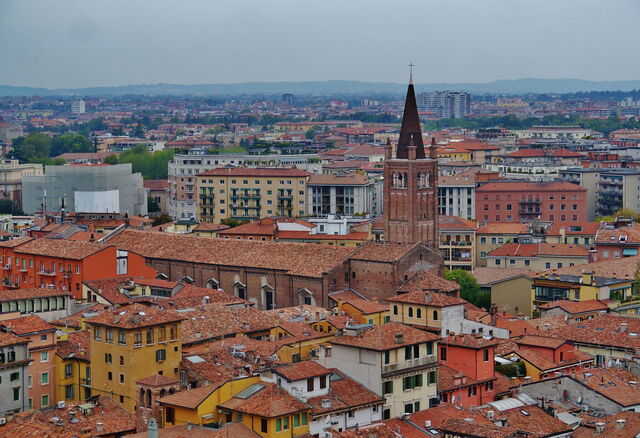
While there was some looting back during the Napoleonic era, which resulted in the losses of some of the truly incredible works of art that once took pride of place in the church (including paintings by Balestra, Ridolfi, Giolfino, and the Brusasorci family) and though the purpose and fate of the building has continued to change so much throughout the centuries, it is a stunning gem once more today. Restored once again in the latter 20th and the 21st century, the building retains a largely Gothic facade and an interior mostly characterised by those alterations and additions from the Renaissance. The vaults display the work of Gaetano Miolato, which dates to the 1930s and includes polychrome frames, liturgical symbols, and three paintings depicting the Nativity, with scenes of the Annunciation and the Presentation of Mary in the Temple on the vault of the nave, a lacunar motif with a central rosette and the Four Prophets in the plumes, on the vault at the transept cross, some coffered decoration and a scene of the Last Supper on the presbytery roof, and a Sacred Heart of Jesus and four saints located in the five segments that make up the apse. These is also a 16th century fresco of St. Paul at the foot of Ananias by Battista del Moro in a chapel, a Magdalene in the 17th century style that was a late work by the 19th century artist Giulio Carpioni, as well as a penitent Saint Jerome by his hand, a 16th century altarpiece by Jacopo Ligozzi, and altarpieces by Francesco Torbido, Domenico Brusasorci, Giovanni Caliari, Agostino Ugolini, and Giambettino Cignaroli, among others. Each of the seven altars on each side of the nave (14 in total) are framed by sculptural decorations made in fine marbles and stone by the likes of the 18th century Veronese sculptor Diomirio Cignaroli and there are various other canvases, sculptural works, frescoes, and bronzes located throughout the church. It is truly like a jewellery box, packed full of incredible works of art.
If you have found a vacation rental in Verona or a vacation rental in Veneto and are exploring this part of Italy, continue with the romantic atmosphere of the city and come see this impossibly pretty gem for yourself as it is an absolute feast for the senses!
If you have found a vacation rental in Verona or a vacation rental in Veneto and are exploring this part of Italy, continue with the romantic atmosphere of the city and come see this impossibly pretty gem for yourself as it is an absolute feast for the senses!
Photo credits
picture 1: Adert / CC BY-SA 4.0;
picture 2: Lo Scaligero / CC BY-SA 4.0;
picture 3: Zairon / CC BY-SA 4.0
picture 1: Adert / CC BY-SA 4.0;
picture 2: Lo Scaligero / CC BY-SA 4.0;
picture 3: Zairon / CC BY-SA 4.0