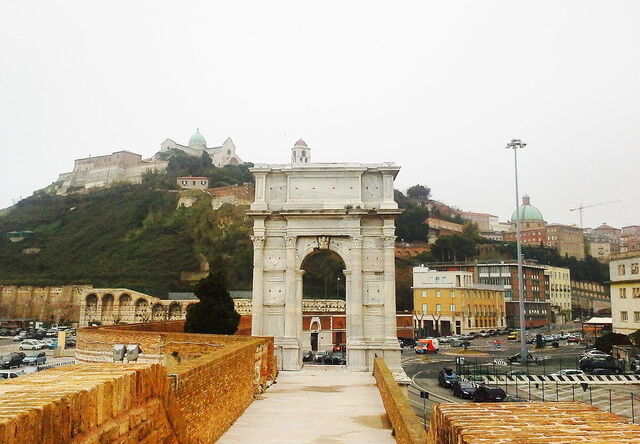
When one thinks of Ancient Roman monuments and architectural gems in Italy, Rome, itself, and Pompeii immediately come to mind. However, one of the most intact ancient Roman commemorative monuments is the Arch of Trajan, located in the town of Ancona, in the Le Marche region. While Italy has endless riches when it comes to cultural gems, this one is especially wonderful as it is far from tourist crowds and can be seen when ever you feel like it. If you are a history nut or just like a finely built structure, just track down a perfect vacation rental in Le Marche and come see this incredible monument for yourself, without having to queue or buy a ticket.
Built at the beginning of the 2nd century AD by the senate and people of Rome in honour of Emperor Trajan, during his reign, it has stood the test of time (though not without some scars). Constructed under Apollodorus of Damascus, the same architect who had been tasked with creating Trajan's markets and column in Rome, it is an 18.5m, single arch, Corinthian-columned monument with multiple cornices, inscriptions and statues – particularly of Neptune – set on a podium near the shoreline of the Adriatic in Ancona and modelled on the Arch of Titus in Rome.
Set in an area originally rejuvenated by Trajan's building up of the port of Ancona, using his own finances, it commemorates the emperor's lasting mark on the town to this day and is a shining glory made from Turkish marble that was brought in from the quarries of Marmara Island. Originally gilt in bronze, the gilding, friezes and statues of the arch were all taken by the Saracens in 848. Still stunning, one can only imagine how it would have looking in all of its glory in the past.
No need to imagine how it looks today, however; just get planning a trip to this iconic structure in Le Marche today!
Set in an area originally rejuvenated by Trajan's building up of the port of Ancona, using his own finances, it commemorates the emperor's lasting mark on the town to this day and is a shining glory made from Turkish marble that was brought in from the quarries of Marmara Island. Originally gilt in bronze, the gilding, friezes and statues of the arch were all taken by the Saracens in 848. Still stunning, one can only imagine how it would have looking in all of its glory in the past.
No need to imagine how it looks today, however; just get planning a trip to this iconic structure in Le Marche today!
Photo credit: Jessy.90 / CC BY-SA 4.0