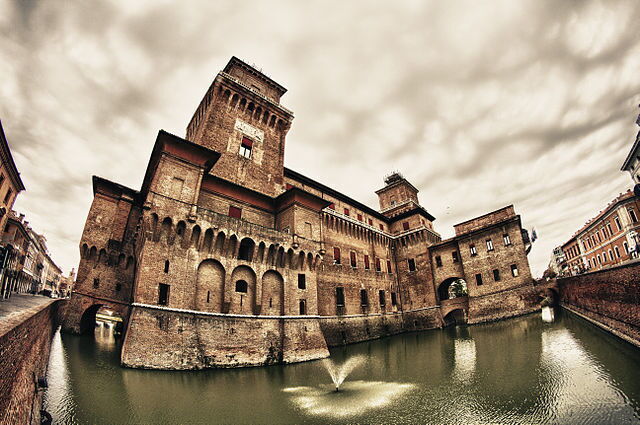
In the 14th century, Ferrara was not the town that one would want to live in. A series of incidents including flooding and the raising of taxes to incredibly high levels left the local people in very dire straits indeed and the descended upon the palace of the d'Este family in search of answers and help. Extreme violence ensued and, Tommaso da Tortona, a high official was literally torn apart by the crowds.
This incident gave the ruling family, the d'Este family, pause to think that, perhaps, their home provided insufficient safety and a new structure was built. A new defensive fortress was built on the north side of the Palazzo under architect Bartolino da Novara.
Pre-existing city walls and structures were strengthened and added to and a passageway was added between Este residence and the new fortress, to allow for escape.
This incident gave the ruling family, the d'Este family, pause to think that, perhaps, their home provided insufficient safety and a new structure was built. A new defensive fortress was built on the north side of the Palazzo under architect Bartolino da Novara.
Pre-existing city walls and structures were strengthened and added to and a passageway was added between Este residence and the new fortress, to allow for escape.
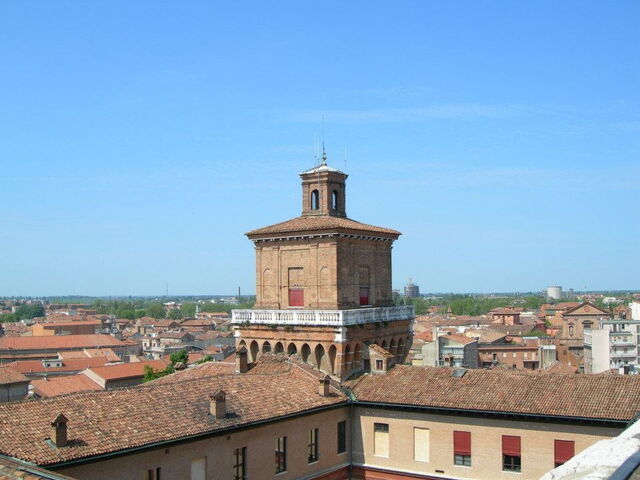
Over time, however, the city grew and the city walls were moved. Form and comfort became more important than defensive function and the d'Este family looked to expanding their living space. A fire in the 16th century then led to construction works that gave us the Castello Estense, pretty much, as we see it today. Girolamo da Carpi's exterior has been altered over the years but there were few drastic changes made.
In the 19th century, the castle came into the possession of the of the state and there were various (if somewhat dubious) bouts of restoration projects throughout the 19th and 20th centuries, particularly after damage during WWII.
From the 21st century onwards, the castle went on to become the important cultural institution that it is today and there have been many important events and exhibitions held there over the years, particularly art exhibitions.
In the 19th century, the castle came into the possession of the of the state and there were various (if somewhat dubious) bouts of restoration projects throughout the 19th and 20th centuries, particularly after damage during WWII.
From the 21st century onwards, the castle went on to become the important cultural institution that it is today and there have been many important events and exhibitions held there over the years, particularly art exhibitions.
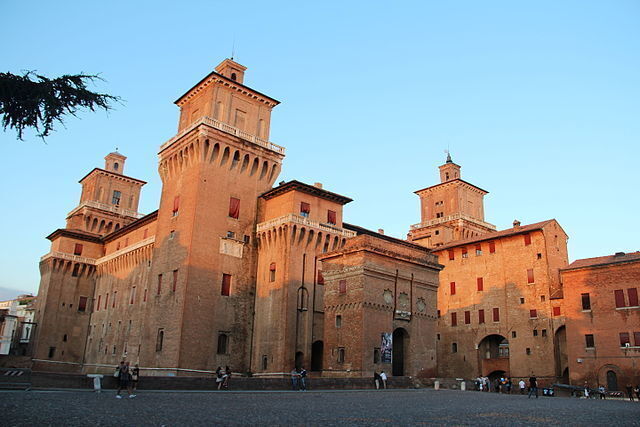
With its moat, remnants of the imposing defensive structure that it once was and the sense of luxury later imposed by the d'Este family, this castle is the quintessential Medieval castle from one's imagination and is an evocative and wonderful place to visit. Inside there are also many more fascinating things to uncover such as the dungeons, scandalous histories and legends, beautiful hanging orange gardens, painted interiors, pretty chapel and endless artworks.
Should you find yourself in this charming part of Italy, the castle truly is an iconic feature of the town and a real must for those visiting it. Just find a villa with pool in Emilia-Romagna and pay a visit.
Should you find yourself in this charming part of Italy, the castle truly is an iconic feature of the town and a real must for those visiting it. Just find a villa with pool in Emilia-Romagna and pay a visit.
Photo credits
Picture 1: Andrea Parisi / CC BY-SA 3.0;
Picture 2: Bebetta25 / CC BY-SA 3.0;
Picture 3: Vassalli.chiara / CC BY-SA 4.0
Picture 1: Andrea Parisi / CC BY-SA 3.0;
Picture 2: Bebetta25 / CC BY-SA 3.0;
Picture 3: Vassalli.chiara / CC BY-SA 4.0