As the Leaning Tower of Pisa is so inordinately and overpoweringly famous, the other sights and attractions of Pisa often don't even get a look in. However, if you have found a luxury villa in Pisa and are visiting that beautiful city, you might wonder what else is there to do in Pisa? Luckily, we have compiled a list of some of the best things to see and do in Pisa that aren't towers with poor foundations.
3. Palazzo Blu
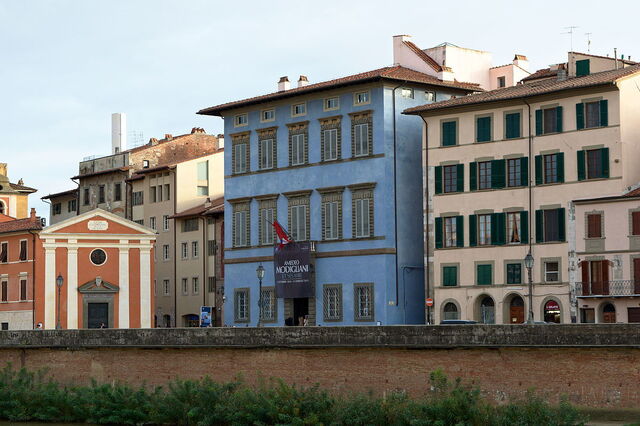
The Palazzo Blu is one of the most important art museums in the city and is, appropriately, located in a wonderfully restored 14th-century dusty-blue palace. Home to Foundation Pisa's art collection (on the 2nd floor of the building) that is made up of predominantly Pisan works from the 14th to the 20th centuries it also hosts various temporary exhibitions on the ground floor throughout the year.
3. Palazzo Blu
The Palazzo Blu is one of the most important art museums in the city and is, appropriately, located in a wonderfully restored 14th-century dusty-blue palace. Home to Foundation Pisa's art collection (on the 2nd floor of the building) that is made up of predominantly Pisan works from the 14th to the 20th centuries it also hosts various temporary exhibitions on the ground floor throughout the year.
These temporary exhibitions can be everything from obscure artists you have never heard of to great household names. Last October, for example, the gallery played host to an exhibition of works by the great Salvador Dalí, the prominent Spanish surrealist painter who is one of the most famous artists of all time, called “Dalí. Il Sogno del Classico” (“Dalí – The Dream of the Classics”). Earlier that same year, there was an exhibition of the works of French illustrator and graphic artist Toulouse-Lautrec, called “Toulouse-Lautrec. Luci e ombre di Montmartre” (“Toulouse-Lautrec – Lights and Shadows of Montmartre”). Admission to the gallery costs €6 for adults and €4 for the reduced rate and allows access to an archaeological area in the basement and restored rooms of 19th century décor of the former aristocratic palace on the 1st floor of the building.
4. Camposanto
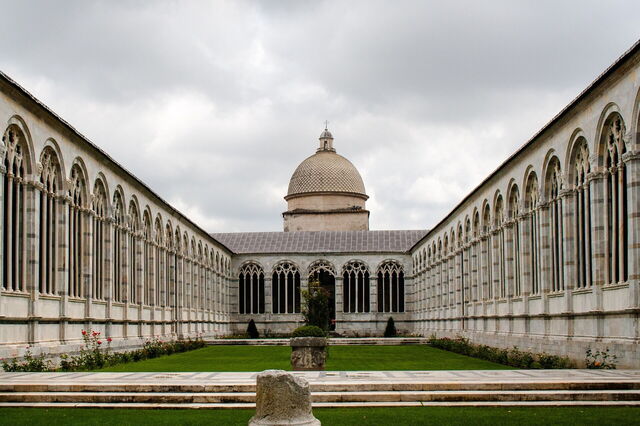
Located right by the Leaning Tower you will find Pisa's Camposanto (literally meaning “holy field”), or Monumental Cemetery, which is the final resting place of important and famous individuals and wonderfully combines stunning architecture and beautiful frescoes.
4. Camposanto
Located right by the Leaning Tower you will find Pisa's Camposanto (literally meaning “holy field”), or Monumental Cemetery, which is the final resting place of important and famous individuals and wonderfully combines stunning architecture and beautiful frescoes.
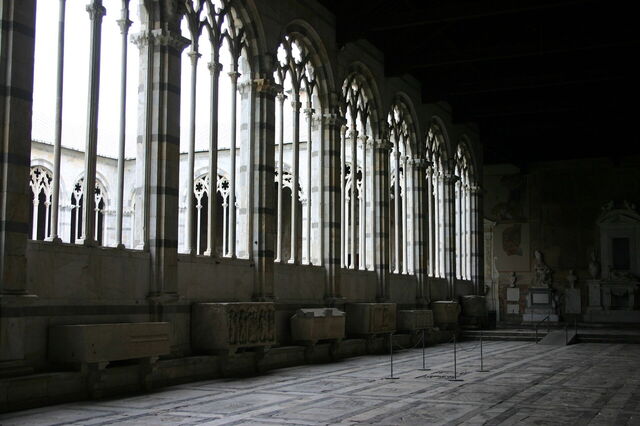
Constructed in 1278, using sacred dirt brought back from Golgotha during the Crusade, it was later decorated with extensive frescoes and was the burial place of the Pisan upper classes for centuries. Additionally, there are funerary monuments, 84 sarcophagi (mostly from the 3rd century AD) and ancient Roman sculptures dotted around the site that are worth examining.
There is more to Pisa than its Leaning Tower so read on to the final post in this series for other things to see and do in this beautiful city.
There is more to Pisa than its Leaning Tower so read on to the final post in this series for other things to see and do in this beautiful city.
Photo credits
picture 1: Japs 88 / CC BY-SA 4.0
picture 1: Japs 88 / CC BY-SA 4.0