
Troubled, gifted and dramatic, Caravaggio is as intriguing as his groundbreaking work. The great Baroque artist was lost to history for a while but was incredibly famous in his own lifetime and is now considered one of the greatest artists of his age once more. While he was born in Milan and spent his relatively short life all over the country (a portion of it on the run), Rome remains one of the best places to see his work. Despite his controversial life, the Church was a big supporter and important patron throughout his career and, as such, much of his work still exists in Rome. Just find a holiday rental in Rome and seek out these examples.
1. Boy with a Basket of Fruit, c.1593
Located in in the Galleria Borghese, this work dates to when Caravaggio was newly arrived in Rome. The model was his friend, the Sicilian painter Mario Minniti, who was around 16 years old at the time. A kind of genre painting, it displays Caravaggio's ability to paint everything from flesh and hair to fabric and fruit.
1. Boy with a Basket of Fruit, c.1593
Located in in the Galleria Borghese, this work dates to when Caravaggio was newly arrived in Rome. The model was his friend, the Sicilian painter Mario Minniti, who was around 16 years old at the time. A kind of genre painting, it displays Caravaggio's ability to paint everything from flesh and hair to fabric and fruit.
As such, it is a clever piece in displaying many of his skills to his new audience. The image is also rather sensual from the light to the food and, particularly, the figure in the image. It is such images of pouty-lipped male youths that have added to the mystery surrounding Caravaggio's life and preferences.
2. Judith Beheading Holofernes, 1599-1602
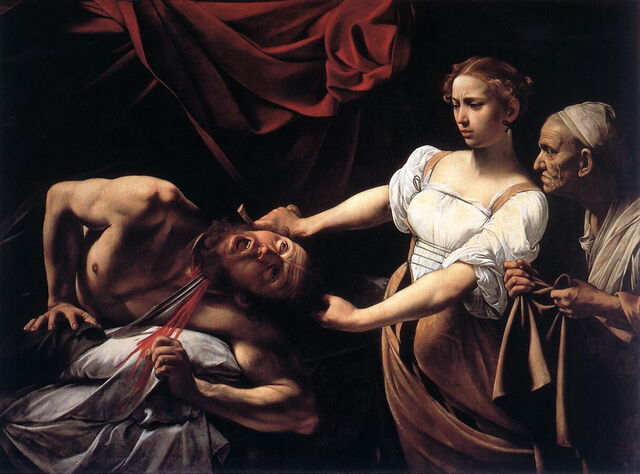
A rather different image is his brutally realistic painting of Judith beheading Holofernes. Judith was a biblical figure and widow who seduced the Assyrian general Holofernes, before decapitating him in his tent, in order to save her people from the tyrant. In the Middle Ages and Renaissance she was depicted like the Virgin, as a pious and righteous figure, but in the 1600s, she began to be shown in the act of killing and in more violent and realistic images. This image by Caravaggio was lost and rediscovered in 1950 and is now part of the collection of the Galleria Nazionale d'Arte Antica.
2. Judith Beheading Holofernes, 1599-1602
A rather different image is his brutally realistic painting of Judith beheading Holofernes. Judith was a biblical figure and widow who seduced the Assyrian general Holofernes, before decapitating him in his tent, in order to save her people from the tyrant. In the Middle Ages and Renaissance she was depicted like the Virgin, as a pious and righteous figure, but in the 1600s, she began to be shown in the act of killing and in more violent and realistic images. This image by Caravaggio was lost and rediscovered in 1950 and is now part of the collection of the Galleria Nazionale d'Arte Antica.

Caravaggio's Judith is the height of these new dramatic depictions, in a theatrically lit shallow stage with compelling emotional displays on the faces of all of the figures. Judith was probably modelled on the Roman courtesan, Fillide Melandroni, a known associate of Caravaggio and another reason he was such a controversial figure.
3. The Conversion on the Way to Damascus, 1601
This dramatic masterpiece was painted in 1601 for the Cerasi Chapel of the church of Santa Maria del Popolo, in Rome. It depicts the moment recounted in Chapter 9 of Acts of the Apostles when Saul, soon to be the apostle Paul, fell on the road to Damascus and heard the call of the Lord. Depicting a moment of intense religious ecstasy, it shows the moment Paul is overcome with the spirit of Jesus Christ after being flung from his horse. Across the chapel is a second Caravaggio painting from 1600, that depicts the inverted Crucifixion of St. Peter, making this chapel a serious Caravaggio hotspot.
For those intrigued and enamoured by the fascinating figure of Caravaggio, a trip to Rome really is a must!
3. The Conversion on the Way to Damascus, 1601
This dramatic masterpiece was painted in 1601 for the Cerasi Chapel of the church of Santa Maria del Popolo, in Rome. It depicts the moment recounted in Chapter 9 of Acts of the Apostles when Saul, soon to be the apostle Paul, fell on the road to Damascus and heard the call of the Lord. Depicting a moment of intense religious ecstasy, it shows the moment Paul is overcome with the spirit of Jesus Christ after being flung from his horse. Across the chapel is a second Caravaggio painting from 1600, that depicts the inverted Crucifixion of St. Peter, making this chapel a serious Caravaggio hotspot.
For those intrigued and enamoured by the fascinating figure of Caravaggio, a trip to Rome really is a must!