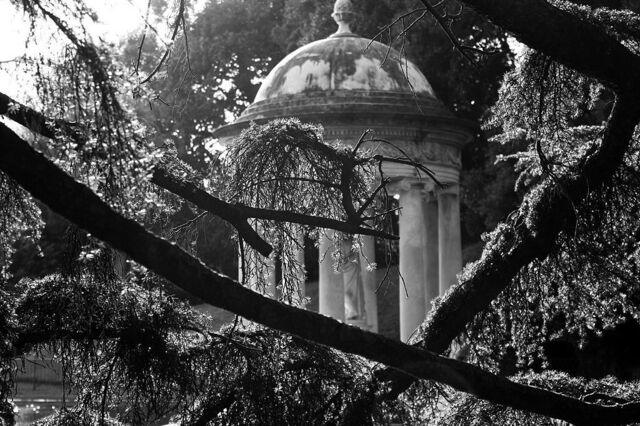
The city of Genoa is an exceptionally beautiful place, a bustling metropolis full of elegant historic buildings, well-planned public squares, dramatic fountains and sweeping thoroughfares. These urban spaces are complemented by the presence of natural oases dotted around the city in the form of public parks. One of these is the park of Villa Durazzo-Pallavicini, a 19th century park in the English Romantic style that is exceptionally beautiful and will completely capture your heart once you step foot inside of it. If you have found a vacation rental in Liguria and are spending some time exploring Genoa, make sure to take a moment for a breather in this beautiful space.
Villa Durazzo-Pallavicini is located in the residential neighborhood of Pegli in Genoa, right next to the railway station. The estate was originally privately owned but was later donated to the state and is open to the public daily as a park and botanic garden. The villa, meanwhile, is home to the Museum of Ligurian Archaeology. Begun in the late 17th century by Clelia Durazzo Grimaldi, who established the Clelia Durazzo Grimaldi Botanic Garden, the estate was enhanced by the creation of the park by her heir and nephew, Ignazio Alessandro Pallavicini. It was designed by Michele Canzio, who was actually the Teatro Carlo Felice's set designer, and created between 1840 and 1846.
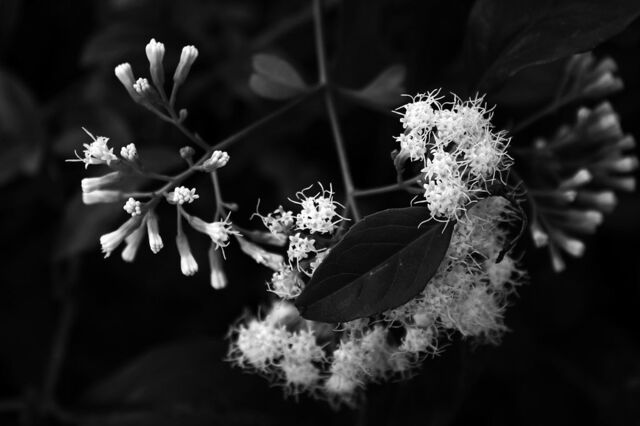
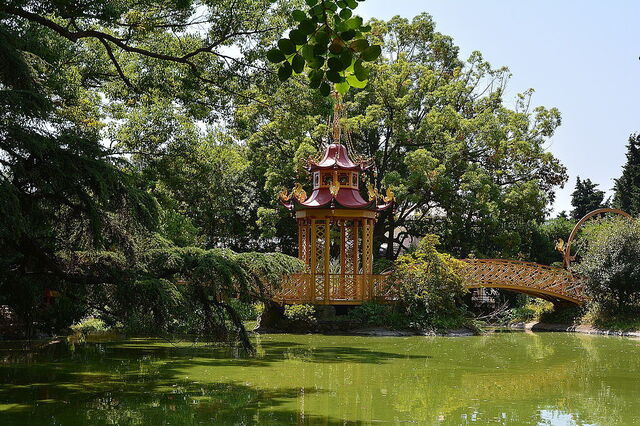
Built on the hillside behind the Villa Durazzo-Pallavicini, the park is executed in the English Romantic style but also displays a theatricality that is surely inherited from its creator. It is organized as a series of scenes forming a play with prologue and three acts (Return to Nature, Memory, Purification). The park contains two ponds, a dozen monuments, numerous statues, and an extensive grotto which is presented as a Dantesque Inferno made up of walkways and an underground lake through which one can ascend once more, towards Paradise. The outstanding monuments include a Coffee House in the shape of triumphal arch, the Rustic House, the Madonna's Chapel, the Mausoleum of the Captain, a Temple of Diana, the Flower House, the Turkish Temple, an Obelisk, and a Chinese Pagoda.
In 1928 the villa's current owner, Matilde Gustinani, donated both park and botanical garden to Genoa for use as a public park. It fell into disrepair in the 20th century and was threatened by the construction of a nearby highway in the 70s. However, in 1991, restoration was undertaken and by 2006 half of the park was open to the public once more.
Scenic and beautiful the park offers something for everyone - a Romantic escape inside the city, history, architecture, art and rare plants. It is truly one of the most wonderful attractions in all of Liguria.
In 1928 the villa's current owner, Matilde Gustinani, donated both park and botanical garden to Genoa for use as a public park. It fell into disrepair in the 20th century and was threatened by the construction of a nearby highway in the 70s. However, in 1991, restoration was undertaken and by 2006 half of the park was open to the public once more.
Scenic and beautiful the park offers something for everyone - a Romantic escape inside the city, history, architecture, art and rare plants. It is truly one of the most wonderful attractions in all of Liguria.
Photo credit
Picture 1: Laurabeppa / CC BY-SA 3.0;
Picture 2: Alessandro.di / CC BY-SA 4.0;
Picture 3: Laurabeppa / CC BY-SA 3.0
Picture 1: Laurabeppa / CC BY-SA 3.0;
Picture 2: Alessandro.di / CC BY-SA 4.0;
Picture 3: Laurabeppa / CC BY-SA 3.0