Napoleon's Edict of Saint-Cloud forbade burials within churches and towns in 1804. Up until that point, people clamoured to be buried on the grounds of the churches that they had attended all their lives but room was swiftly running out and the bodies were unhelpful to the outbreaks of disease and plague that occurred over the centuries. A cholera epidemic, and sudden multiplying of the death-toll, in 1835 further hastened the move to have bodies buried in monumental cemeteries on the outskirts of towns. These same concerns were what led to the establishment of great park cemeteries in Paris and London but lesser known is the Monumental Cemetery of Staglieno in Genoa.
This cemetery, however, is perhaps the most heartrendingly beautiful in the world and a must-see for anyone visiting the area. Find a luxury villa in Liguria and spend a day wandering the grounds.
The Monumental Cemetery of Staglieno was opened in 1851 and has become more elaborate and grown intensely in size since WWI. It combines the architectural structure of a neoclassical cemetery of Mediterranean tradition with the naturalistic cemetery type of northern Europe. The cemetery was designed by Genovese architect Carlo Barabino and is a compromise between the neoclassical tradition and the fashionable wilderness style of boschetto irregulare as at Père Lachaise in Paris.
The Monumental Cemetery of Staglieno was opened in 1851 and has become more elaborate and grown intensely in size since WWI. It combines the architectural structure of a neoclassical cemetery of Mediterranean tradition with the naturalistic cemetery type of northern Europe. The cemetery was designed by Genovese architect Carlo Barabino and is a compromise between the neoclassical tradition and the fashionable wilderness style of boschetto irregulare as at Père Lachaise in Paris.
It is made up of cloisters, garden paths and a reproduction of the Pantheon in Rome.
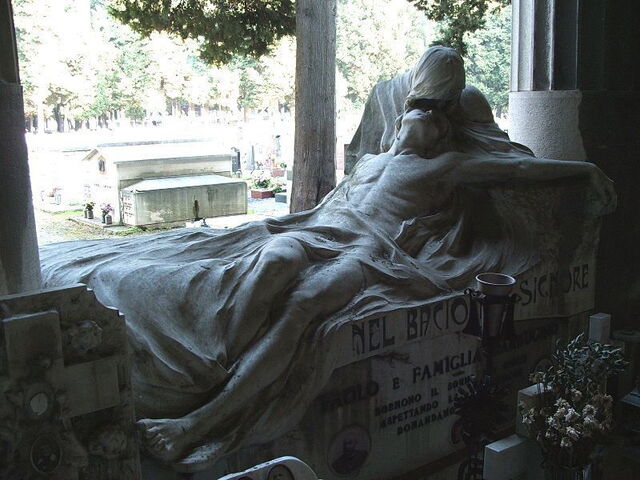
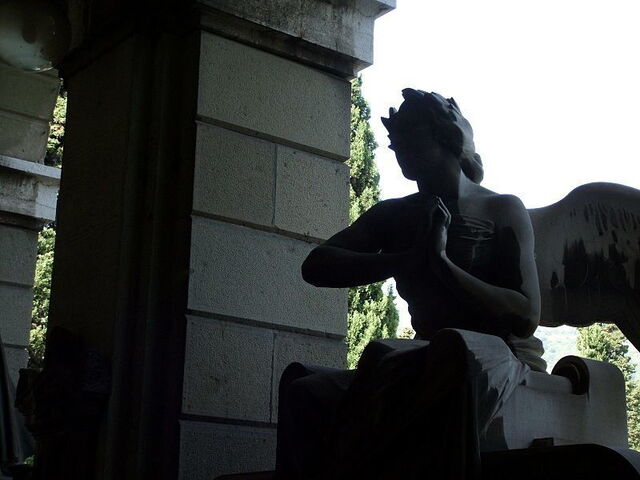
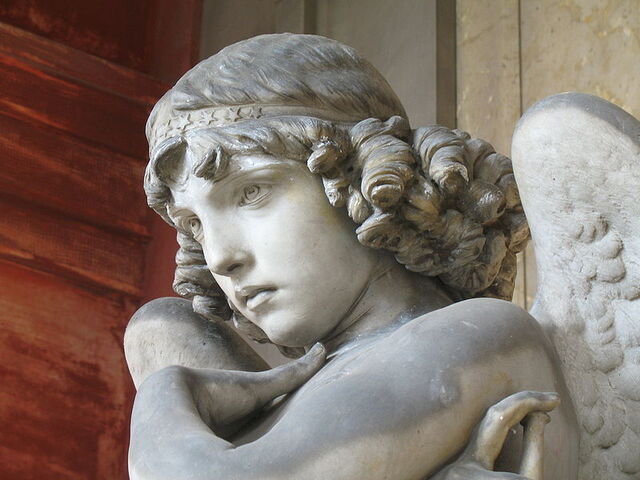
Its statues are the cemetery's most outstanding element, showing swooning angels, maudlin beauties and sorrowful children all set about the grounds at the burial sites of various families.
A variety of styles from subsequent periods are represented by the cemetery with neoclassicism, realism, symbolism, Art Nouveau and Art Deco among them. There are also works by rather famous artists such as Bistolfi, Ximene, Messina and Canonica.
Over the decades, the cemetery has attracted many famous and high-profile visitors including Nietzsche, de Maupassant, Twain and Elisabeth of Austria, who all raved about its beauty. More recently the cemetery came into popular attention again due to a tomb which was used as the cover art for the Joy Division album Closer, released after the death of lead singer Ian Curtis. The tomb, for the Appiani family and by sculptor Demetrio Paernio, shows a family grieving at the deathbed. The cemetery is open to the public daily from 7.30am to 5pm and is well worth a visit if you find yourself in Liguria.
Its statues are the cemetery's most outstanding element, showing swooning angels, maudlin beauties and sorrowful children all set about the grounds at the burial sites of various families.
A variety of styles from subsequent periods are represented by the cemetery with neoclassicism, realism, symbolism, Art Nouveau and Art Deco among them. There are also works by rather famous artists such as Bistolfi, Ximene, Messina and Canonica.
Over the decades, the cemetery has attracted many famous and high-profile visitors including Nietzsche, de Maupassant, Twain and Elisabeth of Austria, who all raved about its beauty. More recently the cemetery came into popular attention again due to a tomb which was used as the cover art for the Joy Division album Closer, released after the death of lead singer Ian Curtis. The tomb, for the Appiani family and by sculptor Demetrio Paernio, shows a family grieving at the deathbed. The cemetery is open to the public daily from 7.30am to 5pm and is well worth a visit if you find yourself in Liguria.
Photo credits
picture 1: Twice25 & Rinina25 / CC BY 2.5;
picture 2: Twice25 & Rinina25 / CC BY 2.5;
picture 3: Twice25 & Rinina25 / CC BY 2.5
picture 1: Twice25 & Rinina25 / CC BY 2.5;
picture 2: Twice25 & Rinina25 / CC BY 2.5;
picture 3: Twice25 & Rinina25 / CC BY 2.5