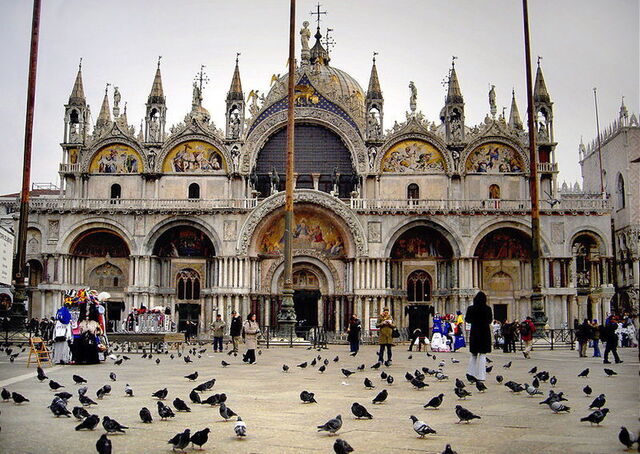
St Mark's Basilica in Venice, is the city's cathedral. The original church was built inside the complex of the Doge's Palace in 828 to house the relics of St. Mark the Evangelist which had supposedly been stolen by Venetian merchants from Alexandria. It was burned to the ground in 976 during an uprising and rebuilt twice. By the time it was to be rebuilt for the second time, the Venetian Republic had become a much greater power and, to symbolise its growing power and wealth, a new basilica complex was built and consecrated in 1094. This is the building that we know today. First, it was only used as the doge's private chapel and became the city's cathedral in the nineteenth century.
Historic, stunning and opulent, it requires finding a holiday rental in Venice and paying a visit to see it for yourself.
It is considered one of the best-regarded examples of Byzantine architecture in the world and particularly well-known for its opulent and gilded interiors. In fact, it is nicknamed the “Chiesa d'Oro”, or Church of Gold. The exterior of the basilica is also ornate, having been much embellished over the centuries with subsequent additions. The façade is divided into five bays by five arched entrances and three registers – lower, upper, domes.
It is considered one of the best-regarded examples of Byzantine architecture in the world and particularly well-known for its opulent and gilded interiors. In fact, it is nicknamed the “Chiesa d'Oro”, or Church of Gold. The exterior of the basilica is also ornate, having been much embellished over the centuries with subsequent additions. The façade is divided into five bays by five arched entrances and three registers – lower, upper, domes.
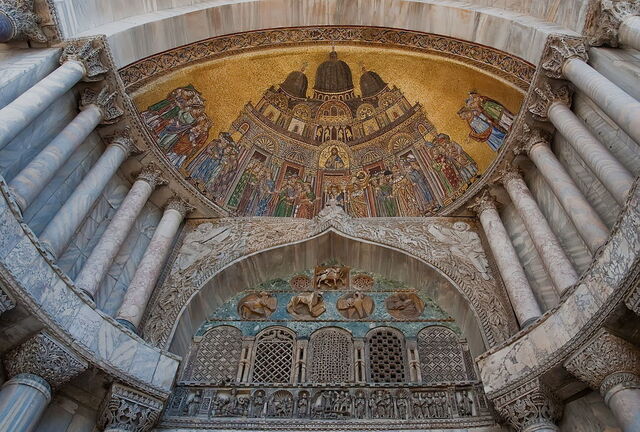
The flanking entrances are capped by mosaics with stories of St Mark's relics and further mosaics on the upper level arches tell stories from Christ's life. Statues also decorate the exterior: the Winged Lion (symbol of Venice), Greek Horses, St Mark and angels and the Four Tetrarchs.
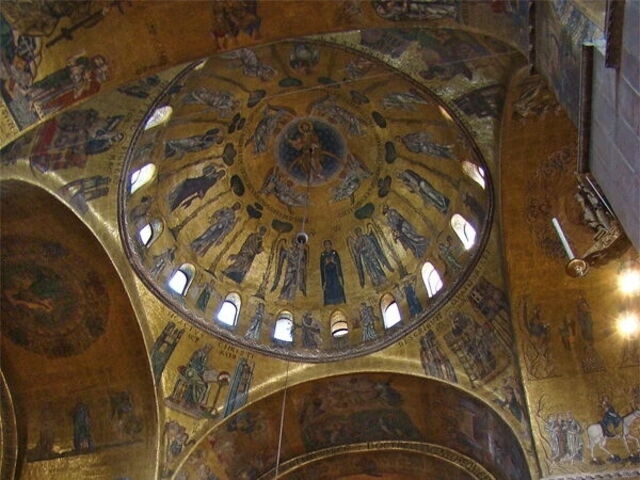
The interior is even more opulent. It is a Greek cross in plan with marble floors in a geometric design, interspersed with images of animals. Gilded mosaics cover the walls and ceilings covering stories from the Old and New Testament and lives of the Virgin, St Peter, St Clement, St John the Evangelist and St Mark.
Some of these are later replacements by major artists such as Titian and Tintoretto. The baldacchino over the high altar, known as the “Golden Pall”, is made of gold decorated with precious gems (2000 emeralds, amethysts, sapphires, rubies, pearls and other gemstones), made by Byzantine goldsmiths at the end of the tenth century. Today this area is, understandably, protected by glass. To the right of the main altar, is the Treasury, home to relics and items taken from Constantinople. The effect of all the gold, gilding and gems is breath-taking and a little over-powering. Certainly unlike anything else you'll see.
It's free to wander the interior circuit and it only takes about fifteen minutes to do so. Be sure to dress modestly with knees and shoulders covered and leave large bags at the storage facility upon entry. There are also free guided tours between April and October at 11am, Monday-Saturday. Stop by and experience a uniquely Venetian attraction.
The interior is even more opulent. It is a Greek cross in plan with marble floors in a geometric design, interspersed with images of animals. Gilded mosaics cover the walls and ceilings covering stories from the Old and New Testament and lives of the Virgin, St Peter, St Clement, St John the Evangelist and St Mark.
Some of these are later replacements by major artists such as Titian and Tintoretto. The baldacchino over the high altar, known as the “Golden Pall”, is made of gold decorated with precious gems (2000 emeralds, amethysts, sapphires, rubies, pearls and other gemstones), made by Byzantine goldsmiths at the end of the tenth century. Today this area is, understandably, protected by glass. To the right of the main altar, is the Treasury, home to relics and items taken from Constantinople. The effect of all the gold, gilding and gems is breath-taking and a little over-powering. Certainly unlike anything else you'll see.
It's free to wander the interior circuit and it only takes about fifteen minutes to do so. Be sure to dress modestly with knees and shoulders covered and leave large bags at the storage facility upon entry. There are also free guided tours between April and October at 11am, Monday-Saturday. Stop by and experience a uniquely Venetian attraction.
Photo credits
picture 1: Ricardo André Frantz / CC BY-SA 2.5;
picture 2: Tango7174 / CC BY-SA 2.5;
picture 3: Roman Bonnefoy / CC BY-SA 2.5
picture 1: Ricardo André Frantz / CC BY-SA 2.5;
picture 2: Tango7174 / CC BY-SA 2.5;
picture 3: Roman Bonnefoy / CC BY-SA 2.5